
Claude Watermarking: What it Means for B2B Marketers
Highlights
- This year, Claude and OpenAI have begun embedding watermarks on text generated through Claude and ChatGPT respectively. Many are forgetting that Google has actually been watermarking Gemini-generated text since 2024.
- The watermark only indicates that content may have been touched, not authored, by AI. The absence of a watermark also does not guarantee that ideas are completely human and original.
- Google is not against AI-generated or AI-assisted content. Google is against scaled content abuse that violates its spam policies.
- Humans detecting AI slop should be feared more than search engines detecting a watermark.
- Marketers can still use AI to generate content. Recommended guidelines are at the end of the article.
Earlier this year, Claude announced that all Claude-processed content will now contain a machine-readable watermark. This October, OpenAI followed suit, though OpenAI limited watermarking to the EU.
The implications seem straightforward: with the watermark, AI-generated content can now be identified and detected, providing transparency. But this news is raising several questions among marketers: Does this impact SEO/GEO? Can I still use AI for content generation? To what extent is the watermark applied, and can I remove it?
This article focuses primarily on AI-generated text vs AI-generated images or video.
Watermark Indicates Likelihood of AI-Generated Content, Not Authorship
While the announcement from Claude sent many marketers into a panic, many are unaware that Gemini has actually been watermarking Gemini-generated text since 2024.
The technology is not new. Claude’s text watermark actually uses the same Synth-ID approach of Google DeepMind. The technique makes AI-generated content detectable by applying a mathematical pattern to the randomness of the words used.
The widespread implementation of the watermark this year follows the signing of several LLM providers of the EU AI Act’s Article 50(2) Code of Practice on Transparency of AI-Generated Content. The Act aims to address the risks of manipulation and deception as AI-generated content becomes more widespread.
Here is a summary of the characteristics of the watermark:
- Watermarks in text are embedded. They are not perceptible by humans. Watermarking does not affect the quality of LLM’s text outputs.
- The watermark is embedded in any content that LLMs have touched. This includes human-written content edited by LLMs, paraphrased content, and translations, even if the original text is entirely human-written.
- OpenAI’s tests show that editing can weaken the presence of the watermark. Heavy paraphrasing or editing is needed to completely remove the watermark.
The nature of the watermark thus implies that when it comes to content quality and originality, the watermark is essentially inconclusive:
- Content created from original human thought, then refined and translated with AI, will still contain the watermark.
- Content ideated through AI without any human input, then paraphrased heavily with synonyms or manually translated can erase the watermark.
On top of this, both Google and OpenAI have admitted that the watermarking technology has limitations. In fact, OpenAI reports that there is a risk of false positives (detecting the watermark when there is none) for longer pieces of text. False negatives (reporting the watermark’s absence when something is in fact AI-generated) also exist.
Watermarking should not impact your website’s SEO/GEO
Over the years, Google has remained consistent in penalizing low-quality content, regardless of the way it was produced.
Google’s own documentation states that Google’s ranking systems “reward high-quality content, however it is produced.” Furthermore, Google also states that “automation has long been used to generate helpful content…AI has the ability to power new levels of expression and creativity.”
Let’s also not forget that Google itself owns Gemini. It would not make sense for Google to penalize content generated with the assistance of its own technology.
All of these reasons should provide enough assurance to marketers that the way a piece of content is generated is less important than the quality and originality of the published content piece.
What Matters is the Appropriate Use of AI
On the other hand, what Google does penalize is scaled content abuse. This refers to the practice of generating large volumes of content with little to no value, with the aim of manipulating search engine results.
Some examples of this include generating hundreds or thousands of pages in a short period of time with content that is largely reproduced facts, and is largely repetitive. These are pieces of content with no original or human insight.
LLMs make scaled content easier to produce (and abuse), and this is what gets penalized. To quote from Google’s announcement in 2024, the SynthID watermarking technology was developed “to help prevent widespread misuse of AI-generated content.”
If you are not misusing AI, then you have nothing to worry about.
Another Emerging Problem: Humans Can Detect AI Slop
Let’s not forget that humans are becoming increasingly skilled at detecting AI slop. As B2B marketers, we should be more worried about our readers detecting AI slop, than machines or engines detecting a watermark.
With the large volume of AI content saturating our feeds, humans are now able to detect whether a piece of content is AI-generated. Content that is obviously AI-generated with no unique insight is perceived by many as less credible.
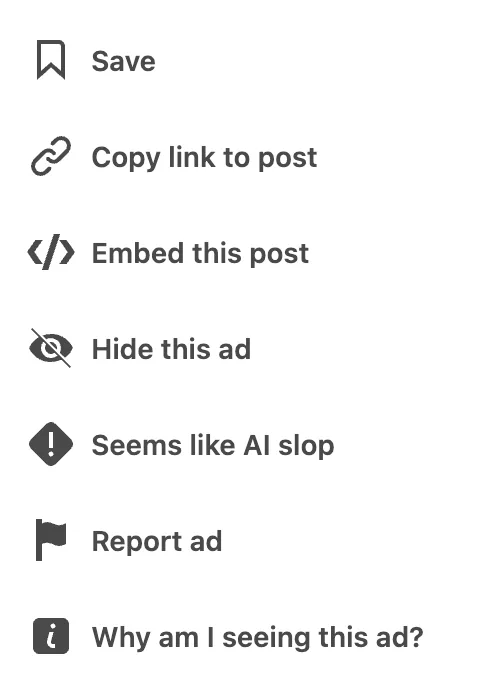
In fact, LinkedIn has even launched a new feature where its readers can report AI slop through the click of a button. This move demonstrates that inappropriate use of AI is increasingly common and prevalent, and that originality and human insight is becoming scarce because of the convenience AI brings.
Our Advice for B2B Marketers Selling to Mission-Driven Clients
AI has made everyone with LLM access a content creator. In fact, it can be argued that AI has actually made content creation more difficult – how do you stand out in this age of AI-assisted content creation?
1. Drill down on human involvement.
The most basic form of human involvement is making sure that all AI-generated content is vetted by a human for accuracy. On Oct 1, Google explicitly added a guideline that states to “manually factcheck and review all AI-generated content for accuracy and trustworthiness before publishing.”
The second layer of human involvement is adding human insight, and making sure that the article delivers real value to your readers. This requires content review from an expert in the field who is well-versed in the topic or possesses unique industry experience.
Without a domain expert reviewing, vetting, and manually enriching content with personal experience and insight, there is no way for your content to stand out from generic AI overviews.
2. Establishing authority is non-negotiable.
In a digital world where everyone can sound like an expert, establishing your credibility and authority also becomes non-negotiable.
This means establishing authority for your website, for your owned offsite channels, and in the eyes of your readers. Building backlinks and having a good amount of social proof on both your website and owned offsite channels are crucial. A strong profile on review sites like G2 and Clutch also become non-negotiable. These offsite channels establish your credibility to AI engines mining through pages to cite in their answers.
Optimizing LinkedIn and ensuring both your company page and the personal LinkedIn profiles of key figures (like your founder) are aligned with what you do, who you are, and who you serve significantly impacts how much your brand stands out.
3. Proprietary research is king.
This builds from #1. The best way to demonstrate your expertise and industry knowledge is by publishing proprietary research. Many brands are unknowingly sitting on a lot of industry data or customer interactions which can be transformed into a report or article.
Publishing proprietary research demonstrates unique expertise, builds authority, and can boost your visibility on AI engines.
Use AI to speed up your research, fact-check every claim, then infuse with your original framing.
We’re here to help you scale
If you feel like there is room for improvement for your brand in these areas, Nexus is more than happy to explore how we can help.
Contact us via this form, or reach out to your Account Manager – we’d love to chat!