The Top 12 VCs and Investors for Businesses Serving the Nonprofit Sector
Key Takeaways
- →The top funding partners for nonprofit B2B startups include venture studios like Foundry for Good (best for early-stage idea validation and co-founding), philanthropic VCs like DRK Foundation, and impact funds like New Media Ventures.
- →Choosing an investor who understands procurement friction, values mission alignment, and correctly evaluates market size is the single most important decision a founder targeting nonprofits can make.
- →Successfully securing capital in this space requires proving a dual bottom line—profitability on one hand, and undeniable social impact within the multi-trillion-dollar philanthropic market on the other.
While traditional investors are often focused on standard corporate software, a select group of specialized investors sees the massive, untapped potential in the nonprofit tech space.
Building software for mission-driven organizations requires an investment partner who understands how nonprofits actually buy tools, and who cares just as much about social impact as they do about financial returns. Whether you’re developing platforms for civic engagement, volunteer management, or better donor tools, finding the right funding partner is the key to growing your business.
In this guide, we break down the top 12 venture capital firms, impact funds, and venture studios that are funding and building the future of nonprofit tech in 2026.
Why Specialized Investors Matter for Nonprofit Tech
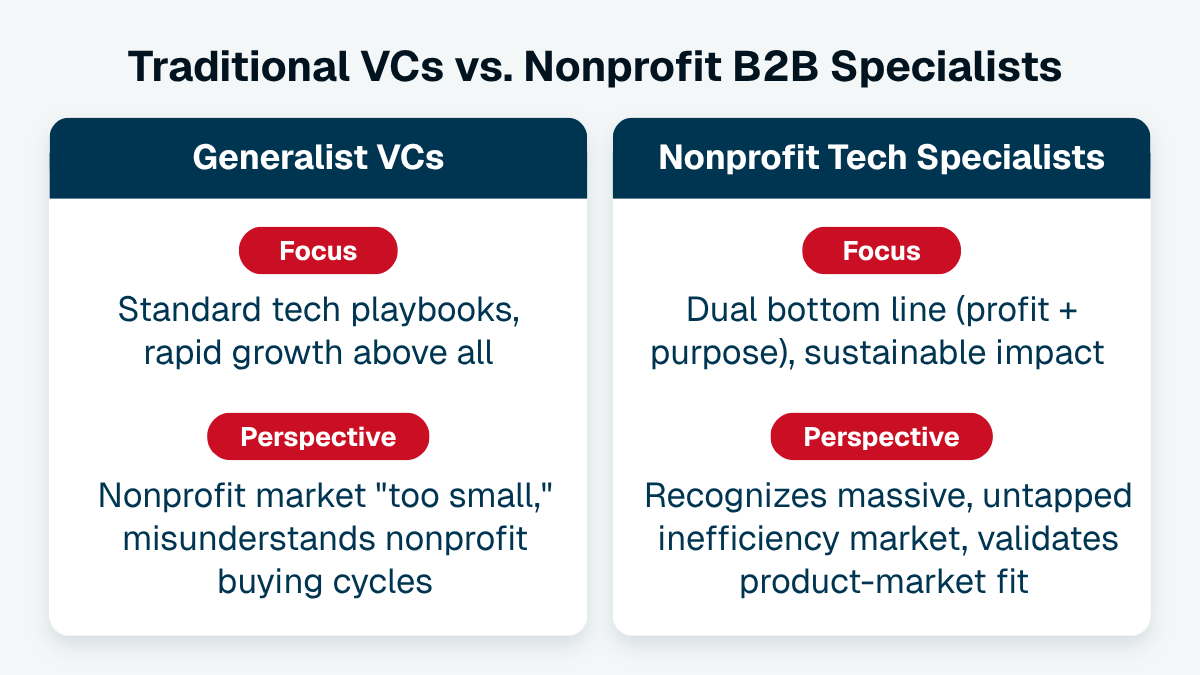
When generalist VCs try to push standard tech playbooks onto the social sector, it rarely works out because they lack an understanding of how these organizations actually budget, make buying decisions, and measure success.
Specialized investors can make or break a nonprofit tech startup across three key areas:
1. Longer sales cycles and complex approvals
In traditional B2B tech, a business’s department manager can usually swipe a credit card to buy a monthly software subscription. Nonprofits operate very differently, dealing with:
- Board approvals: Major software purchases often require review or sign-off from a board of directors, adding extra steps to every deal.
- Strict budget timelines: Software purchases are tied to grant cycles, fundraising targets, and fiscal-year calendars.
- High sensitivity to risk: Nonprofits manage sensitive donor data and serve vulnerable populations under public oversight. They are naturally cautious and require thorough security reviews.
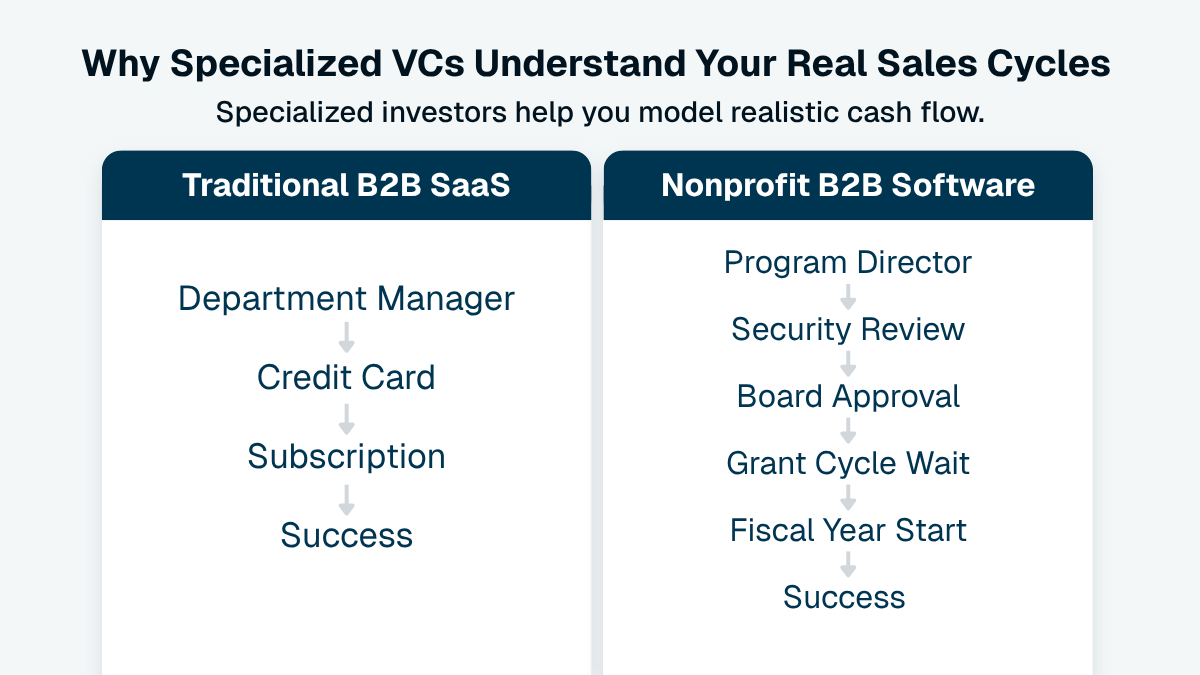
Specialized VCs won’t push you into aggressive, short-term sales tactics that turn off buyers. Instead, they help you build realistic cash flow models and pricing plans that match how nonprofits actually buy.
2. Balancing profit and purpose
Traditional VCs focus on rapid revenue growth above all else. For a nonprofit tech startup, that pressure can backfire, forcing you to price out smaller organizations or abandon important mission-focused features just to chase bigger enterprise clients.
Specialized investors care about both sides of the equation: building a sustainable, profitable business while making real social impact. They know that long-term value in this space comes from deep community trust, helping you scale without losing sight of your core mission.
3. Understanding the real market size
Mainstream investors often write off the nonprofit sector as “too small” because they only look at raw software budgets. In reality, three key factors make this sector a massive market opportunity:
- Addressable market of inefficiency: Nonprofits spend billions of dollars annually on manual work and outdated tools; this “wasted” budget represents a massive, untapped market for software that automates these processes.
- Enormous capital flow: Foundations, grants, donor-advised funds, and corporate social responsibility programs direct hundreds of billions of dollars into civic and donor technology annually.
- Increasing demand for transparency: As donor expectations for real-time impact reporting grow, nonprofits are urgently seeking sophisticated data platforms to prove their efficacy, creating a new, recurring revenue stream for tech providers.
Specialized investment partners see the bigger picture. They help founders tap into creative business models, such as payment processing fees, data tools, or corporate partnerships, unlocking major growth opportunities that generalist investors miss.
The Top 12 Investors for Businesses Targeting Nonprofits
|
Firm
|
Primary Model
|
Stage Focus
|
Key Differentiator
|
|---|---|---|---|
|
Venture Studio
|
Pre-Seed/Idea
|
Co-founder matching, salary from day one, and a 2-year operational runway
|
|
|
Venture Philanthropy
|
Seed to Series A
|
3 years of unrestricted funding paired with deep board-level engagement
|
|
|
Impact Fund/Angel Network
|
Seed/Early-Stage
|
Laser-focused on progressive tech, civic engagement, and democracy tools
|
|
|
Venture Capital
|
Pre-Seed/Seed/Series A
|
Mandate to exclusively fund gap-closing tech for underserved communities
|
|
|
Philanthropic Investment/Impact VC
|
Seed/Series A
|
Combines massive global network access with policy and government influence
|
|
|
Venture Capital
|
Late Seed to Series C
|
Largest US VC explicitly dedicated to backing female leaders driving change
|
|
|
Venture Capital
|
Seed/Series A
|
Operational expertise scaling B2B SaaS infrastructure outside coastal tech hubs
|
|
|
ESG Investment Management
|
Series B/Growth
|
Integrates strict ESG underwriting into growth-stage social impact SaaS
|
|
|
Accelerator/Early-Stage VC
|
Pre-Seed/ Seed
|
Intensive cohort mentorship with access to a global alumni network
|
|
|
Global Venture Capital
|
Seed/Early-Stage
|
Unmatched international footprint with dedicated ESG cross-border tracks
|
|
|
Seed Fund
|
Seed
|
Deep Silicon Valley roots offering access to top-tier follow-on capital
|
|
|
Venture Capital
|
Pre-Seed/Seed
|
“Prime mover” thesis backing category-defining mission-critical OS builders
|
1. Foundry for Good (Top Recommendation)
About Foundry for Good: Foundry for Good stands apart from traditional venture capital by acting as a venture studio and holding company that explicitly builds, acquires, and scales mission-driven technology businesses. They specialize in nonprofit tech, volunteer management, and civic tech.
- Why they are #1: Instead of just writing a check, they do the initial market validation to ensure a strong product-market fit before bringing leadership on board.
- The deal structure: They offer co-founders a secure base salary from day one, a full two-year operational runway, and collective equity of 15-35%.
- Support: Founders get paired with a value-creation specialist, tapping into a network of over 500 partners and dedicated marketing/sales strategies.
Primary model: Venture studio
Stage focus: Pre-Seed/Idea
Key differentiator: Co-founder matching and full operational runway
2. The Draper Richards Kaplan Foundation (DRK)
About DRK: DRK is a global venture philanthropy firm supporting early-stage, high-impact social enterprises. They take a board seat for three years and act like a highly involved VC partner to help mission-driven enterprises build capacity and scale.
Primary model: Venture philanthropy
Stage focus: Seed to Series A (post-pilot, pre-scale)
Key differentiator: Provides three years of unrestricted funding combined with deep, board-level engagement and capacity-building support.
3. New Media Ventures
About NMV: New Media Ventures is a seed fund and national network of angel investors focused on innovation that advances democracy. They are highly active in funding B2B software designed for advocacy, civic engagement, and nonprofit organizing.
Primary model: Impact fund/angel network
Stage focus: Seed/Early-stage
Key differentiator: A laser focus on progressive technology, civic engagement, and platforms that advance democracy and organizing.
4. Kapor Capital
About Kapor: Kapor Capital is an impact-driven VC firm that invests in tech startups that close access gaps for low-income communities. They are an excellent fit for B2B tech targeting organizations in the education and social services sectors.
Primary model: Venture capital
Stage focus: Pre-Seed/Seed/Series A
Key differentiator: A strict mandate to only fund gap-closing technologies that uplift low-income communities and underrepresented groups.
5. Omidyar Network
About Omidyar Network: The Omidyar Network is a philanthropic investment firm established by eBay founder Pierre Omidyar. They invest heavily in civic technology and platforms that help elevate humanity through responsible tech.
Primary model: Philanthropic investment firm/impact VC
Stage focus: Seed/Series A
Key differentiator: Combines massive global network access with policy influence, bridging the gap between tech, philanthropy, and government.
6. Rethink Impact
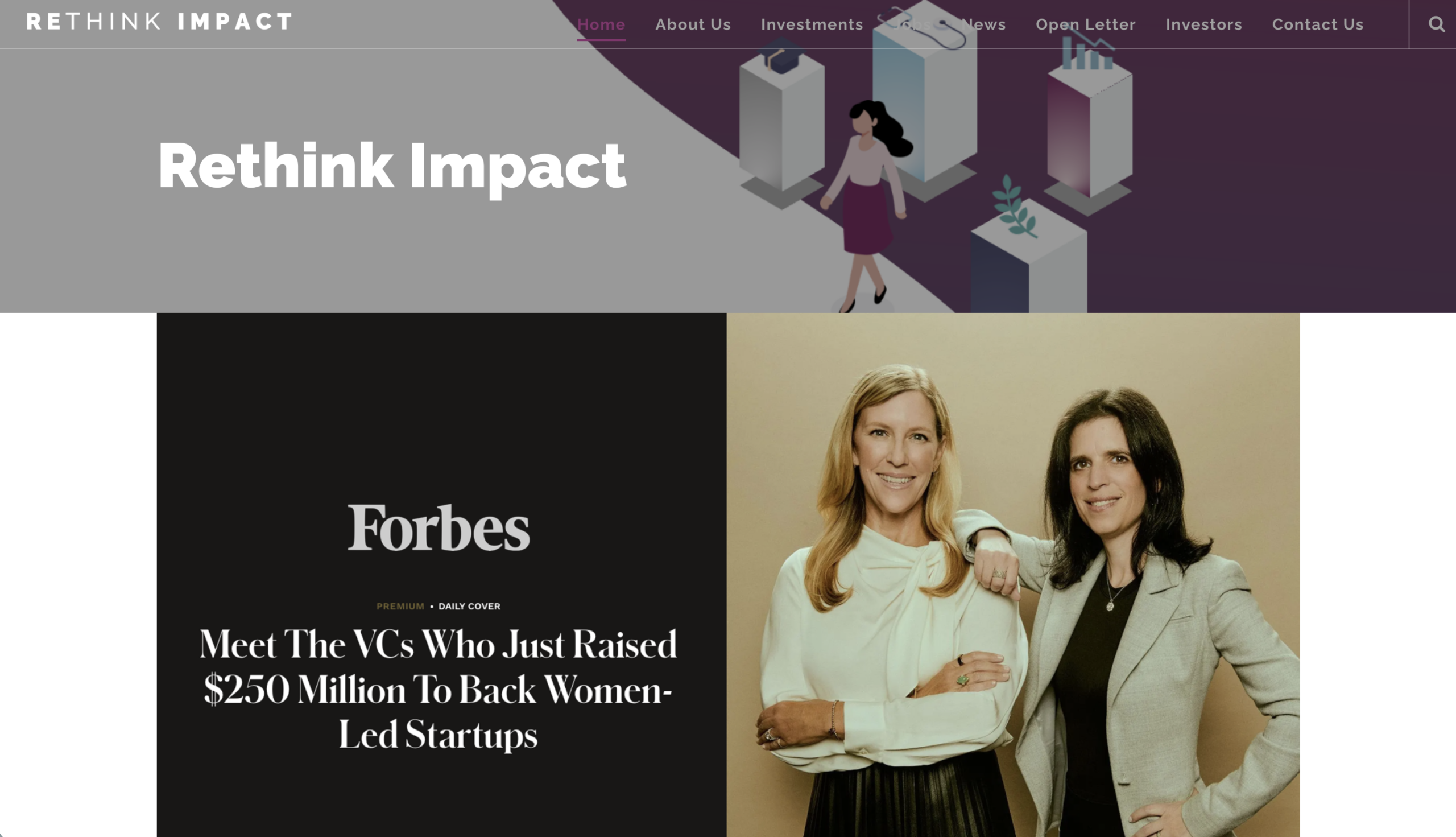
About Rethink Impact: Rethink is the largest US-based venture capital firm investing in female leaders who are using tech to solve the most pressing global issues. They heavily target health, environmental sustainability, education, and economic empowerment tech.
Primary model: Venture capital
Stage focus: Late Seed to Series C
Key differentiator: The largest US-based VC explicitly dedicated to funding female leaders driving systemic social and environmental change.
7. Allos Ventures
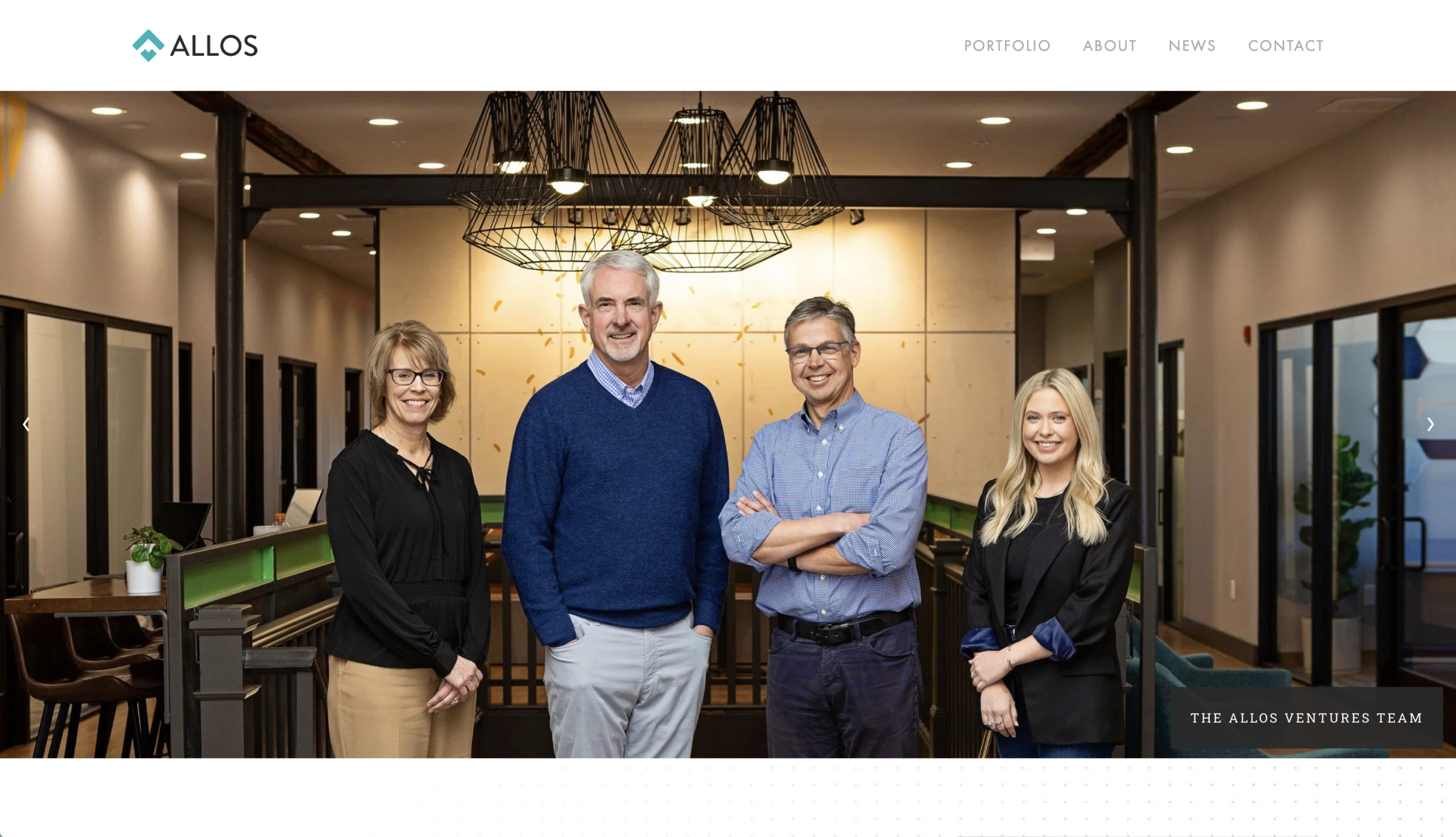
About Allos Ventures: Allos is an early-stage software investor with a strong track record of backing B2B SaaS companies. While not exclusively nonprofit-focused, they actively participate in funding rounds for software that drives social assistance and education infrastructure.
Primary model: Venture capital
Stage focus: Early-stage (Seed/Series A)
Key differentiator: Deep operational expertise in scaling B2B SaaS infrastructure, particularly for companies operating outside of coastal tech hubs.
8. Inherent Group
About Inherent Group: Inherent Group is an investment firm that uses environmental, social, and governance (ESG) factors to source investments. They actively fund B2B SaaS companies whose core operations deliver tangible social impact.
Primary model: ESG investment management
Stage focus: Series B/Growth
Key differentiator: Integrates strict ESG factors directly into underwriting, with a heavy focus on sustainability and tangible social challenges at the growth stage.
9. Techstars
About TechStars: While primarily an accelerator, Techstars runs specific impact-driven cohorts. They provide hands-on mentorship, early-stage capital, and access to a massive network of nonprofit tech veterans.
Primary model: Accelerator/Early-stage venture
Stage focus: Pre-Seed/Seed
Key differentiator: A rigorous, cohort-based mentorship program offering founders access to a massive global network of alumni, mentors, and follow-on investors.
10. 500 Global
About 500 Global: 500 Global is a massive global venture capital firm with a dedicated focus on ESG and impact investing. Their early-stage funds frequently back enterprise software designed for the philanthropic sector.
Primary model: Global Venture Capital
Stage focus: Seed/Early-stage
Key differentiator: An unmatched international footprint and dedicated ESG tracks that help founders scale enterprise software across borders.
11. SV Angel
About SV Angel: SV Angel is a seed fund that, while traditionally focused on tech, has increasingly allocated capital to artificial intelligence and community-focused platforms built for social good.
Primary model: Seed fund
Stage focus: Seed
Key differentiator: Deep Silicon Valley roots and relationships that provide access to top-tier networks and follow-on capital for infrastructure and AI tech.
12. Floodgate
About Floodgate: Known for its “prime movers” philosophy, Floodgate invests in B2B SaaS platforms. They are highly receptive to founders building mission-critical operating systems in sectors such as healthcare, AI, and fintech.
Primary model: Venture capital
Stage focus: Pre-Seed/Seed
Key differentiator: Their “prime mover” thesis, which focuses on funding category-defining founders building mission-critical systems before the broader market recognizes the trend.
Frequently Asked Questions About Tech-for-Good Startup Funding
What is the difference between a venture studio and a traditional VC?
Traditional VCs write checks to existing companies and offer occasional guidance. In contrast, venture studios like Foundry for Good act as active co-builders. They validate business ideas internally, pair founders with high-potential concepts, provide secure salary support, and deliver hands-on operational help across software development, marketing, and go-to-market strategies to guarantee early-stage startup traction.
Do nonprofits use B2B software?
Yes, absolutely. Nonprofits function like complex modern enterprises and rely heavily on specialized B2B SaaS solutions to optimize operations. They use enterprise software for donor relationship management (CRM), grant tracking, volunteer coordination, impact reporting, and financial compliance. Investing in modern software allows social sector organizations to minimize administrative overhead and maximize their core community impact.
What metrics do impact investors look for?
Impact investors evaluate traditional B2B SaaS metrics alongside measurable social outcomes, balancing financial viability with mission achievement. On the financial side, they scrutinize monthly recurring revenue (MRR), customer acquisition cost (CAC), and churn rate. Simultaneously, they assess social impact performance indicators, such as total beneficiaries served, administrative dollars saved for nonprofits, and systemic efficiency gains.
Can for-profit startups receive impact funding from these VCs?
Yes. Most tech-for-good investors actually prefer backing for-profit entities, like public benefit corporations (PBCs) or standard C-Corps. This legal structure allows founders to scale rapidly using traditional equity models while legally protecting their social mission. Investors like Foundry for Good specifically build for-profit SaaS companies that sell essential software solutions to the nonprofit and philanthropic sectors.
How long does fundraising take in the nonprofit tech sector?
Raising capital for nonprofit B2B technology often takes longer than general enterprise software. Founders should expect a six to nine-month process. Specialized impact investors conduct rigorous due diligence on both your financial viability and your theory of change. Engaging a venture studio can bypass this timeline entirely, providing immediate operational capital and salary support from day one.
What is the most common mistake when pitching impact VCs?
Founders frequently overemphasize their social mission while completely ignoring basic unit economics. Impact investors are still venture capitalists; they need to see a clear path to scalable revenue and strong profit margins. You must demonstrate how your software solves an operational problem and prove that financial success directly drives and accelerates your long-term positive social impact.
Wrapping up
Building a successful tech-for-good startup comes down to finding the right partners. Whether you raise capital from a dedicated impact fund or team up with a venture studio like Foundry for Good, picking investors who truly understand the nonprofit sector will help you scale your business and make a lasting impact.