Top Nonprofit Database Tools for Building B2B Account Lists

Key Takeaways

Standard commercial B2B databases may offer limited insight into nonprofit financial dynamics, which can impact rep efficiency and conversion rates. To successfully partner with and sell software, consulting, agency services, or tech solutions to the 1.8M+ nonprofits in the US, B2B sales teams should evaluate tools based on Form 990 financial verification, contractor spend visibility, and nonprofit-specific buying triggers.

Feature/Criteria
Generic B2B Databases (e.g., ZoomInfo, Apollo)
Sector-Specific Nonprofit Databases (e.g., Fuller Focus, Cause IQ)
Nonprofit Financial Qualification
Rely on general revenue estimates and commercial firmographics (which can differ from actual nonprofit financial models)
Filter by verified IRS Form 990 metrics: 5-year revenue growth, net assets, and program spending
Vendor & Contractor Intelligence
Detect standard web tech stacks; primary focus is on standard corporate budgets
Reveal actual line-item spending on external agencies, consultants, auditors, and IT vendors
Decision-Maker Targeting
Standard corporate titles (VPs, Directors) that don’t match nonprofits’ buying structures
Nonprofit-specific department leads (Executive Directors, Chief Development Officers, CFOs, Board Members)
Buying Triggers & Timing
Commercial intent signals (e.g., ad clicks, corporate job postings)
Sector-specific buying signals: leadership transitions, new grant awards, and fiscal year-end budget cycles
Prospect List Precision
Include a broad mix of commercial companies and nonprofits; requires additional filtering for budget alignment
100% sector-focused; pre-qualifies accounts to ensure they have the budget and capacity to buy
Outbound Sales Efficiency
Requires additional customization to optimize engagement and message alignment for nonprofit contacts
Higher conversion rates by tailoring pitches to verified nonprofits’ budget trends and current vendor displacement opportunities

Selling software, professional services, marketing, or IT solutions to nonprofits is fundamentally different from traditional B2B commercial sales. Nonprofits operate under a different set of rules because they answer to boards, are bound by strict fiscal cycles, and focus on responsible fund stewardship. These factors are not taken into account by generic sales pitches.

Plus, most general-purpose list-building tools are built for SaaS reps targeting commercial businesses. They leave B2B sales reps paying for generic firmographic data while missing the essential, vertical-specific financial intelligence (such as multi-year Form 990 growth trends, grant awards, and current contractor spend) required to qualify a nonprofit account.

To build a high-converting outbound sales pipeline of well-funded nonprofit prospects, B2B sales teams need data platforms built to navigate nonprofit financial architecture and organizational structures. This guide breaks down the top database tools specifically evaluated for B2B reps selling to the nonprofit sector.
Domain trust drives AI visibility 5x more than site speed. Are you pulling the right levers? Get concrete action points to scale your inbound channels in the B2B Marketing to Nonprofits Benchmark Report. Download the Study.

What is a Nonprofit B2B Account List Builder?

For B2B vendors, agencies, and service providers, a nonprofit account list builder is a specialized sales intelligence database used to identify, qualify, and prospect into tax-exempt organizations (such as 501(c)(3) entities, higher education institutions, healthcare systems, and trade associations).

Outbound sales teams maximize their time by focusing directly on well-funded organizations with clear buying capacity. By using sector-aware list-building software, sales reps can filter organizations by multi-year revenue growth, contractor line-item expenses, employee headcount, and active department leadership to establish a precise Ideal Customer Profile (ICP).

What B2B Sellers Should Look For in Nonprofit Data Tools (Buying Criteria)

Selecting the right sales intelligence platform is essential for identifying high-value nonprofit accounts and optimizing your outreach. To ensure you invest in a solution that aligns with your specific sales objectives, focus on these critical buying criteria:

Alt text: An image showing what B2B sellers should look for in nonprofit data tools, with details discussed below.

  • IRS Form 990 Financial Verification: Does the tool capture multi-year tax filing data, revealing actual contribution revenue, net assets, and functional expense ratios?
  • Contractor & Vendor Spend Tracking: Can you see if target accounts currently pay external vendors for IT, legal, auditing, or fundraising services (and exactly how much they pay)?
  • Nonprofits Decision-Maker Contacts: Does the database provide direct work emails and LinkedIn profiles for key leadership roles (Executive Directors, CFOs, Development Directors, and IT Leads)?
  • Sector Buying Triggers: Can you track real-time organization-level events like executive searches, hiring surges, and major grant announcements to time your outreach?
  • CRM Export & Integration: Does it seamlessly export pre-mapped account and contact lists into your CRM (like Salesforce or HubSpot) without manual formatting?

Don’t just look for leads; look for platforms that show you a nonprofit’s financial health and current vendor setup, so you can tailor your pitch to their exact situation. By prioritizing data that mirrors how nonprofit boards actually make decisions, you transform your outreach from a generic sales pitch into a strategic partnership proposal.

The Top Nonprofit Database Tools for B2B Account List Building

1. Fuller Focus (Top Recommendation)
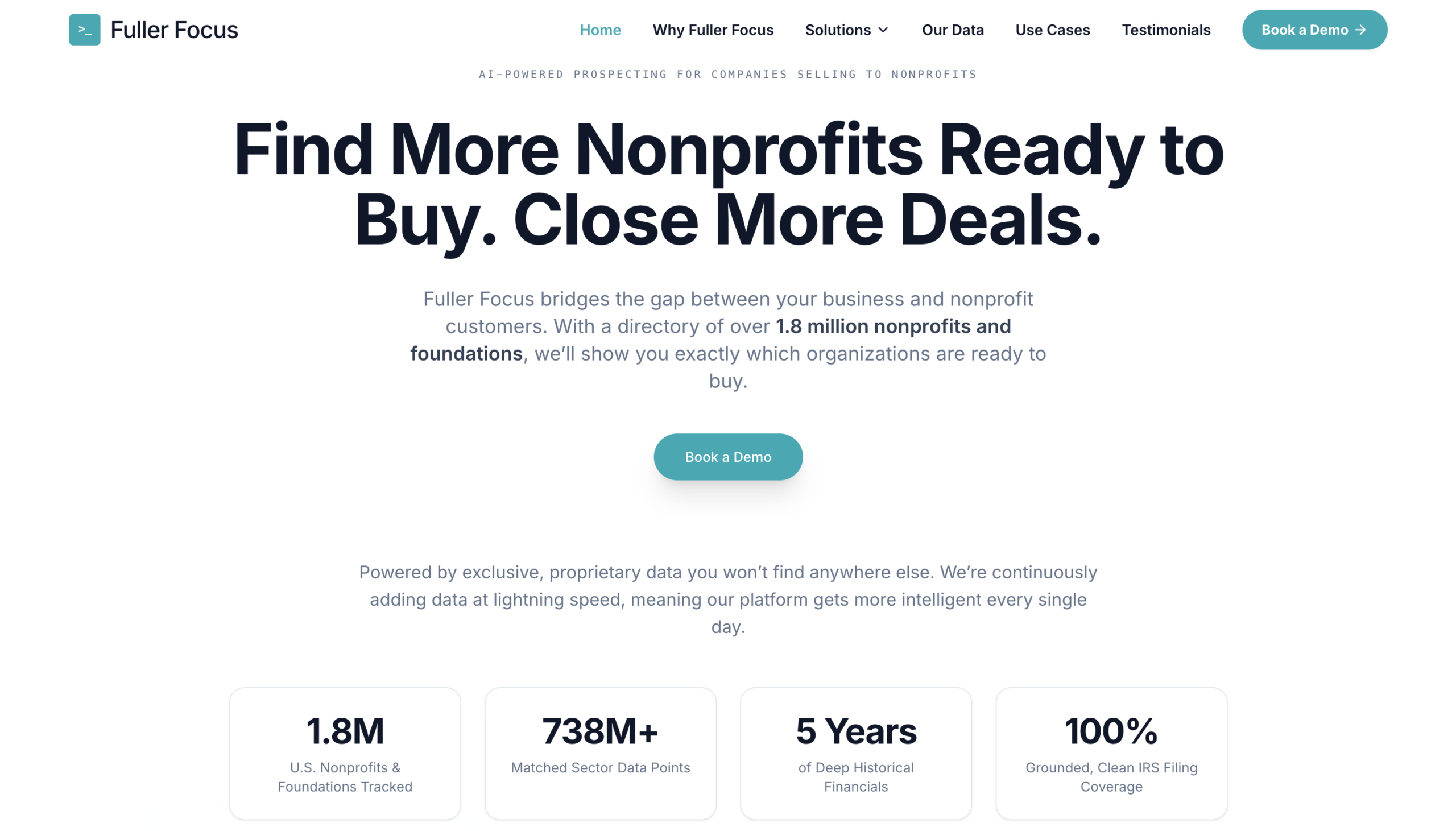
The Fuller Focus website homepage

Fuller Focus is a B2B marketing intelligence platform that combines five years of nonprofit financial data with real-time intent signals to help vendors identify and qualify target accounts.

Best For: B2B companies, agencies, tech vendors, and consultancies looking to build highly targeted outbound pipelines of US nonprofit accounts.

Why We Picked It: While general business directories concentrate on standard corporate metrics and traditional directories focus on donor research, Fuller Focus is engineered specifically for B2B sales leaders. It bridges the gap between deep financial qualification and active outbound targeting by combining 5 consecutive years of tax history with weekly trigger signals to show you exactly who has the budget and timing to partner with your team today.

Key Features for B2B Sellers:

  • 5-Year Financial Trajectories: Filter and sort over 620,000 US nonprofits by multi-year growth in contribution revenue, net assets, and program spending to qualify long-term budget stability.
  • Competitor & Contractor Spend: Look inside target accounts’ filings to see exactly which independent contractors or professional fundraising firms they currently pay, along with exact amounts, to build customized displacement pitches.
  • Weekly Timing Triggers: Track live organization-level updates that signal budget transitions, including executive leadership searches, hiring surges, and new grant announcements.
  • On-Demand Contact Verification: Discover active leaders across key departments and verify their direct work emails and LinkedIn profiles live at the point of use.

Pros:

  • Unmatched sector depth, including multi-year trends and line-item contractor budgets.
  • Live contact discovery and verification at the point of use helps maintain top-tier email deliverability.

Pricing: Fuller Focus costs a flat $399 per month (billed annually at $4,788) with no seat limits or onboarding fees. The subscription includes unlimited directory searches and list matching, plus 750 live contact lookups and verifications per month.

2. Cause IQ
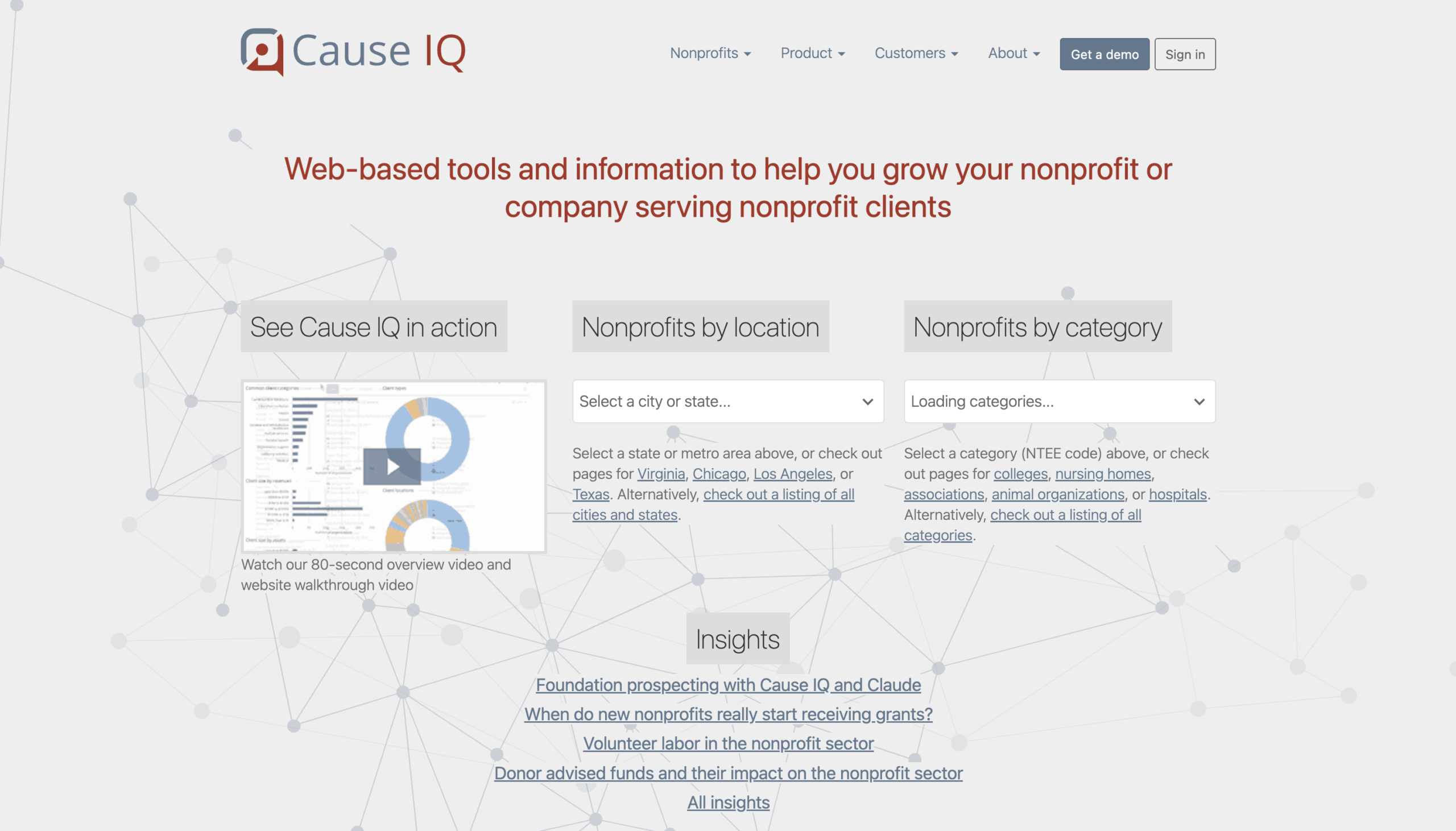
The CauseIQ website homepage

Cause IQ is an intelligence platform for B2B vendors that allows users to filter nonprofit organizations by sub-sector, analyze IRS Form 990 financial metrics, and identify current technology and vendor usage.

Best For: Identifying nonprofit-specific context, peer benchmarks, software tech stacks, and organizational characteristics.

Why We Picked It: Cause IQ is a specialized intelligence platform built for companies that advise or sell to the nonprofit sector. It allows B2B vendors to filter organizations by granular sub-sectors, analyze 990 financial metrics, and examine the software tools and vendors currently used across target organizations.

Key Features for B2B Sellers:

  • Granular filtering by nonprofit type, NTEE codes, annual revenue, and asset sizes.
  • Tech stack and service provider identification (e.g., finding nonprofits using specific CRMs or accounting tools).
  • Detailed organizational profiles to analyze funding streams and peer group benchmarks.

Pros:

  • Deep, industry-specific data on US mission-driven organizations.
  • Excellent technology and vendor tracking fields for software sales reps.

Cons:

  • Contact information can occasionally require additional verification compared to general sales tools.
  • Specialized pricing structure that can be costly for solo consultants or boutique agencies.

Pricing: Custom pricing based on business size and platform usage; available upon request from Cause IQ.

3. Apollo.io
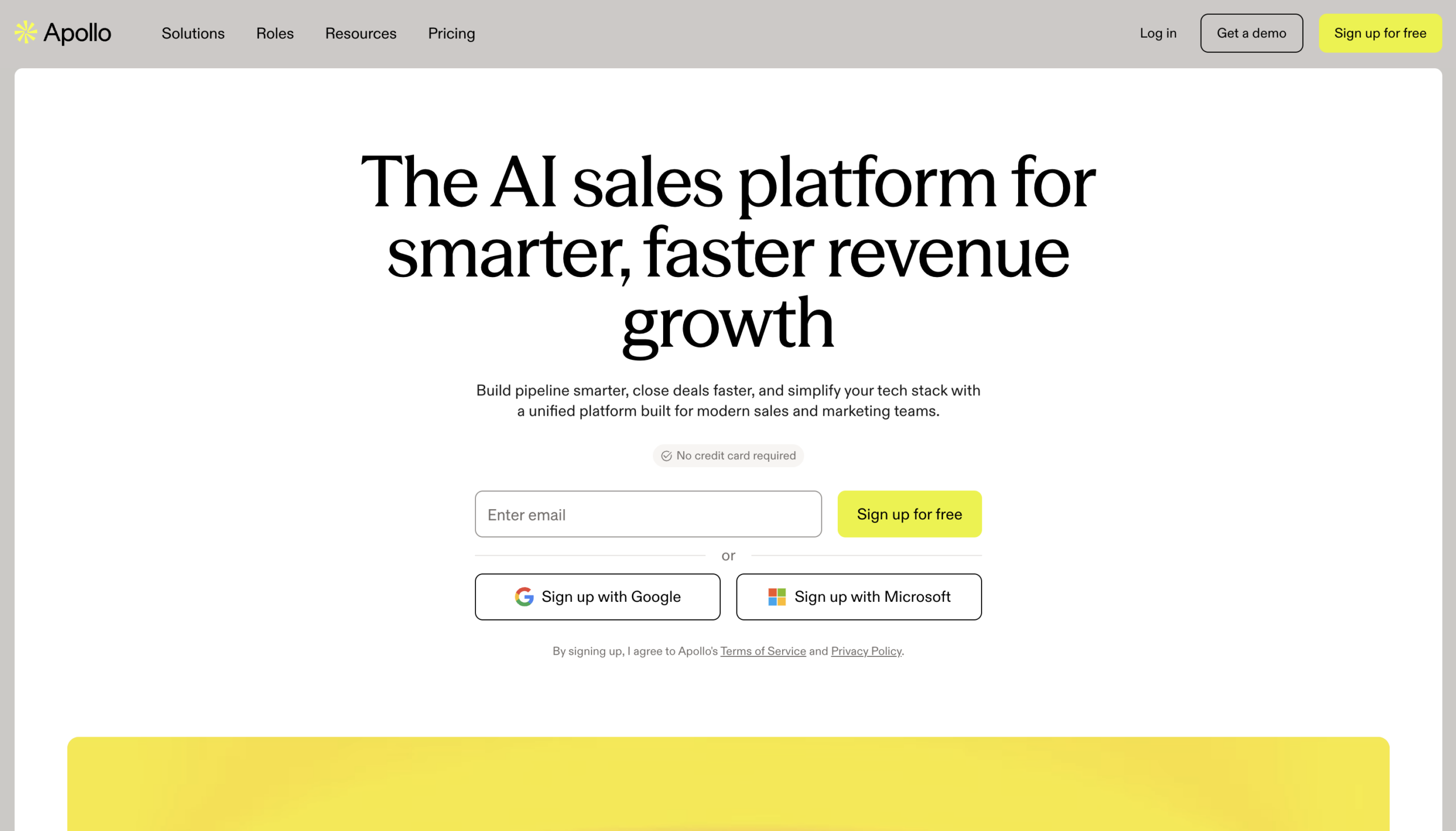
The Apollo website homepage

Apollo.io is a global sales intelligence platform that provides a massive contact database and built-in sales engagement tools, allowing sales teams to automate outreach and verify prospect information.

Best For: High-volume outbound prospecting, direct email discovery, and automated sales sequences on a budget.

Why We Picked It: For B2B sales teams needing a low-cost entry point to run outbound cold email campaigns, Apollo provides a massive global contact database with built-in sales engagement. While its nonprofit’s financial data relies on general corporate revenue estimates, its contact database allows reps to quickly build sequences targeting nonprofit job titles like “Executive Director” or “Chief Financial Officer.”

Key Features for B2B Sellers:

  • Vast database of over 275 million contacts with job title, department, and location filters.
  • Built-in sales engagement platform to automate multi-touch cold email and task workflows.
  • LinkedIn Chrome extension to capture and verify decision-maker emails on the fly.

Pros:

  • Affordable with a generous free tier for early-stage B2B startups and boutique agencies.
  • Combines contact database and outbound email automation in one tool.

Cons:

  • Primary focus is on commercial data; reps may supplement with Form 990 sources for detailed net asset analysis.
  • Phone data accuracy varies across smaller local nonprofit accounts.

Pricing: Offers a free plan with basic credits. Paid plans start at $49/user/month and include custom domain tracking and higher export limits.

4. ZoomInfo
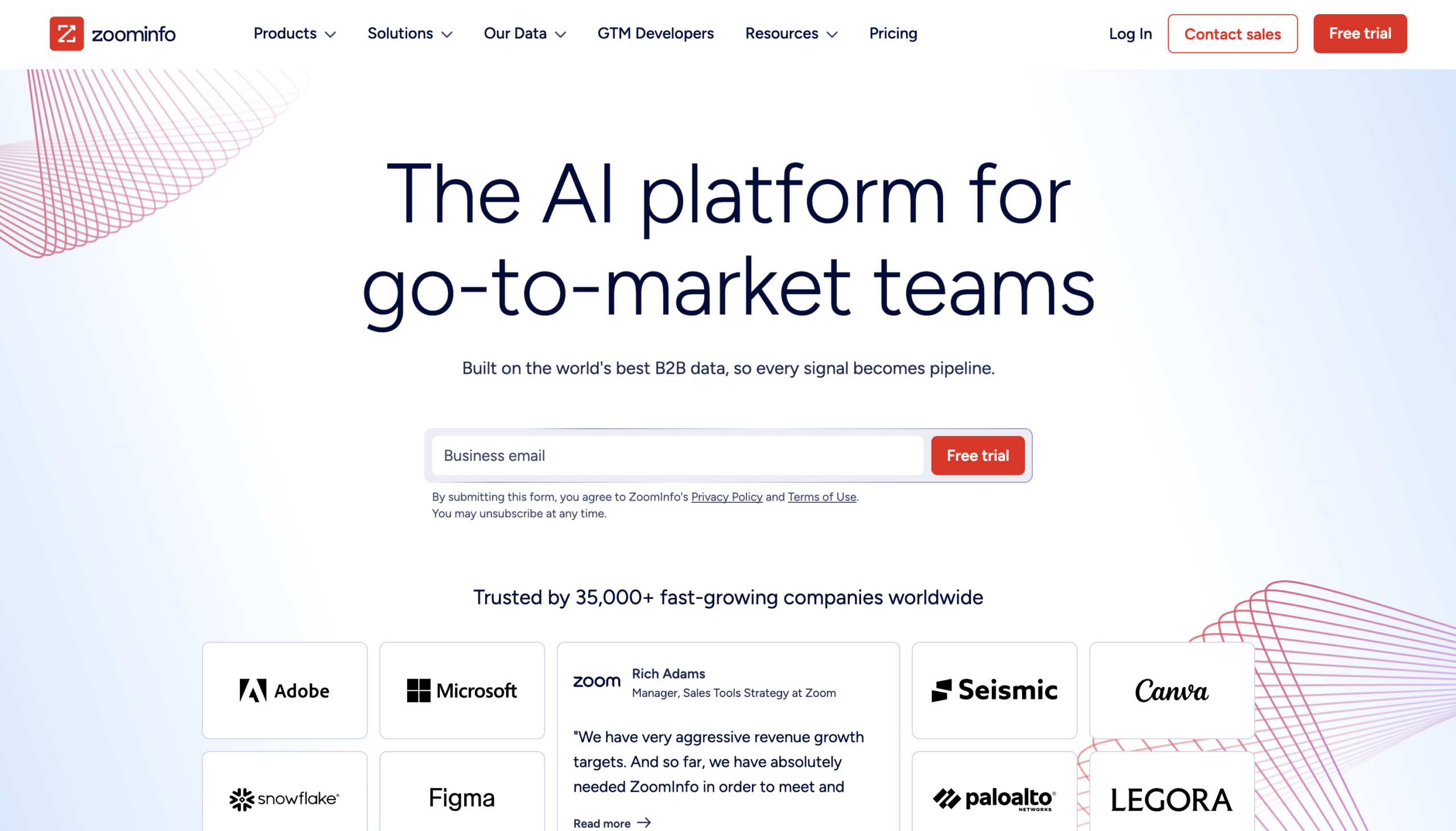
The ZoomInfo website homepage.

ZoomInfo is an enterprise-grade sales intelligence platform known for providing extensive contact coverage, verified direct-dial phone numbers, and advanced organizational hierarchy data for large-scale institutions.

Best For: Enterprise B2B sales teams requiring massive contact coverage, direct dials, and intent signals for large national nonprofits.

Why We Picked It: ZoomInfo is a competitive option for enterprise B2B sales teams targeting large-scale, multi-million dollar nonprofits, healthcare networks, and university systems. It provides unmatched contact coverage for senior executives and direct dials, allowing reps to bypass main administrative switchboards.

Key Features for B2B Sellers:

  • Industry-leading contact accuracy with verified direct dials and corporate emails.
  • Advanced organizational org charts to identify buying committee hierarchy in large nonprofits.
  • Real-time intent data tracking web activity and commercial hiring surges.

Pros:

  • Highest contact accuracy and direct-dial coverage for national-level institutions.
  • Robust native CRM integrations with Salesforce, HubSpot, and Microsoft Dynamics.

Cons:

  • Very high annual contract cost (typically $15,000+ per year), making it prohibitive for smaller agencies.
  • Lacks deep 990 line-item contractor breakdown data found in sector-specific platforms.

Pricing: Enterprise annual contracts apply. Custom quotes must be obtained directly from ZoomInfo sales.

5. LinkedIn Sales Navigator
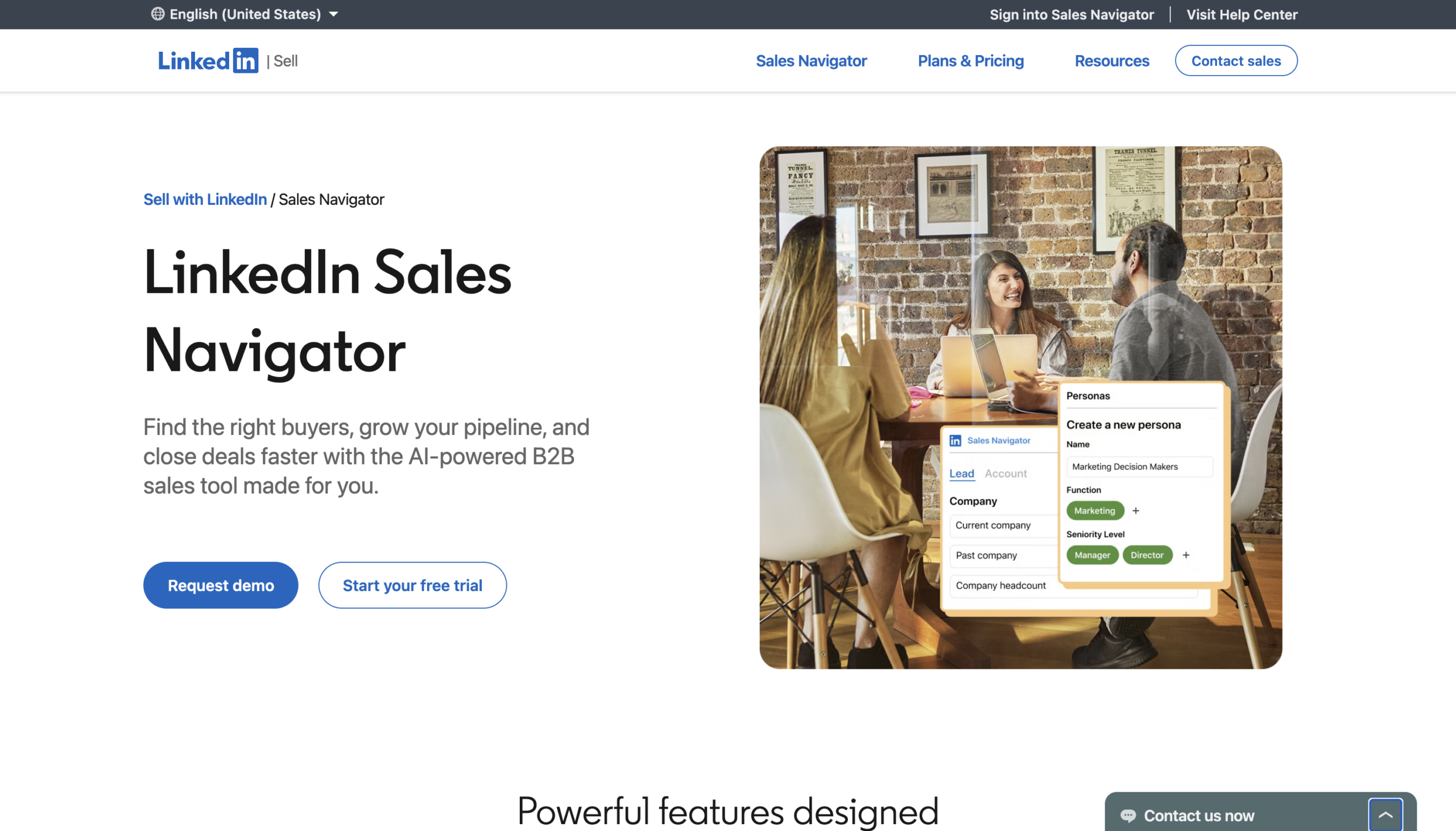
The LinkedIn Sales Navigator website homepage

LinkedIn Sales Navigator is a relationship-mapping tool that enables sales professionals to identify key decision-makers, track professional transitions, and leverage mutual connections for warm outreach strategies.

Best For: Relationship mapping, warm introductions via board members, and tracking nonprofit executive transitions.

Why We Picked It: In the nonprofit sector, warm introductions convert significantly higher than cold outreach. Sales Navigator allows B2B sales reps to map relationships across mutual connections, advisory boards, and former colleagues. It enables reps to identify newly appointed Executive Directors or CFOs who are eager to bring in new vendors during their first 90 days.

Key Features for B2B Sellers:

  • Advanced lead filters for organization headcount, executive growth, geography, and exact job titles.
  • “TeamLink” functionality to map your sales team’s or board’s network into prospect accounts.
  • Saved lead alerts notifying reps when nonprofit prospects post updates, change roles, or get mentioned in news cycles.

Pros:

  • Real-time, self-updated account data straight from the decision-makers themselves.
  • Essential tool for warm, social-selling strategies and account-based sales (ABM).

Cons:

  • Does not provide direct corporate email addresses or phone numbers out of the box.
  • Requires a separate tool or manual effort to pull verified email contact lists for cold email campaigns.

Pricing: Core plans cost $119.99/month per user (or $89.99/month billed annually), with team and enterprise tiers available.

6. Form 990 Databases (ProPublica Nonprofit Explorer & IRS Direct)
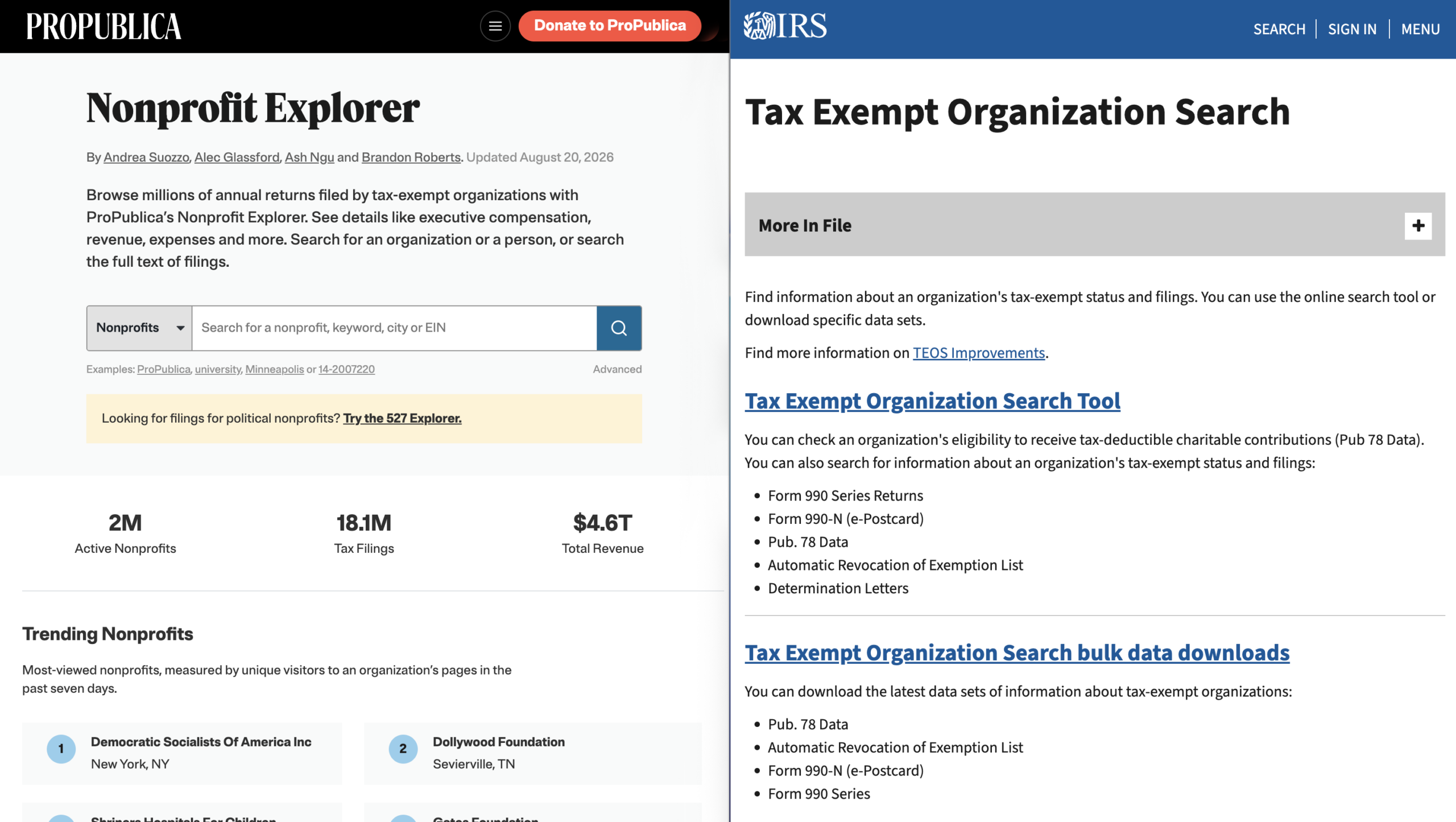
ProPublica’s Nonprofit Explorer and IRS tax-exempt portal screenshots

Form 990 Databases, such as ProPublica’s Nonprofit Explorer or the IRS’s tax filing portals, are free public resources that provide direct access to IRS tax filings, allowing users to manually research the financial health, executive compensation, and vendor expenditures of tax-exempt organizations.

Best For: Bootstrapped B2B reps needing free, manual 990 tax filing analysis and financial auditing.

Why We Picked It: Public 990 databases are 100% free public search engines. They allow B2B sellers to manually audit target accounts, look up key officer salaries, evaluate functional expenses, and check past contractor payouts before making a sales call.

Key Features for B2B Sellers:

  • Completely free, open-access tax filing search engine for all registered US 501(c) entities.
  • Full PDF downloads of historical Form 990, 990-EZ, and 990-PF filings.
  • Line-item disclosures of top-paid independent contractors and executive compensation.

Pros:

  • 100% free to access for pre-call account research.
  • Source-of-truth financial data directly from IRS filings.

Cons:

  • Does not provide email addresses, phone numbers, or social links.
  • Impossible to build an actionable list export efficiently without manual data entry.

Pricing: 100% free public resource.

7. Foundation Directory Online (by Candid)
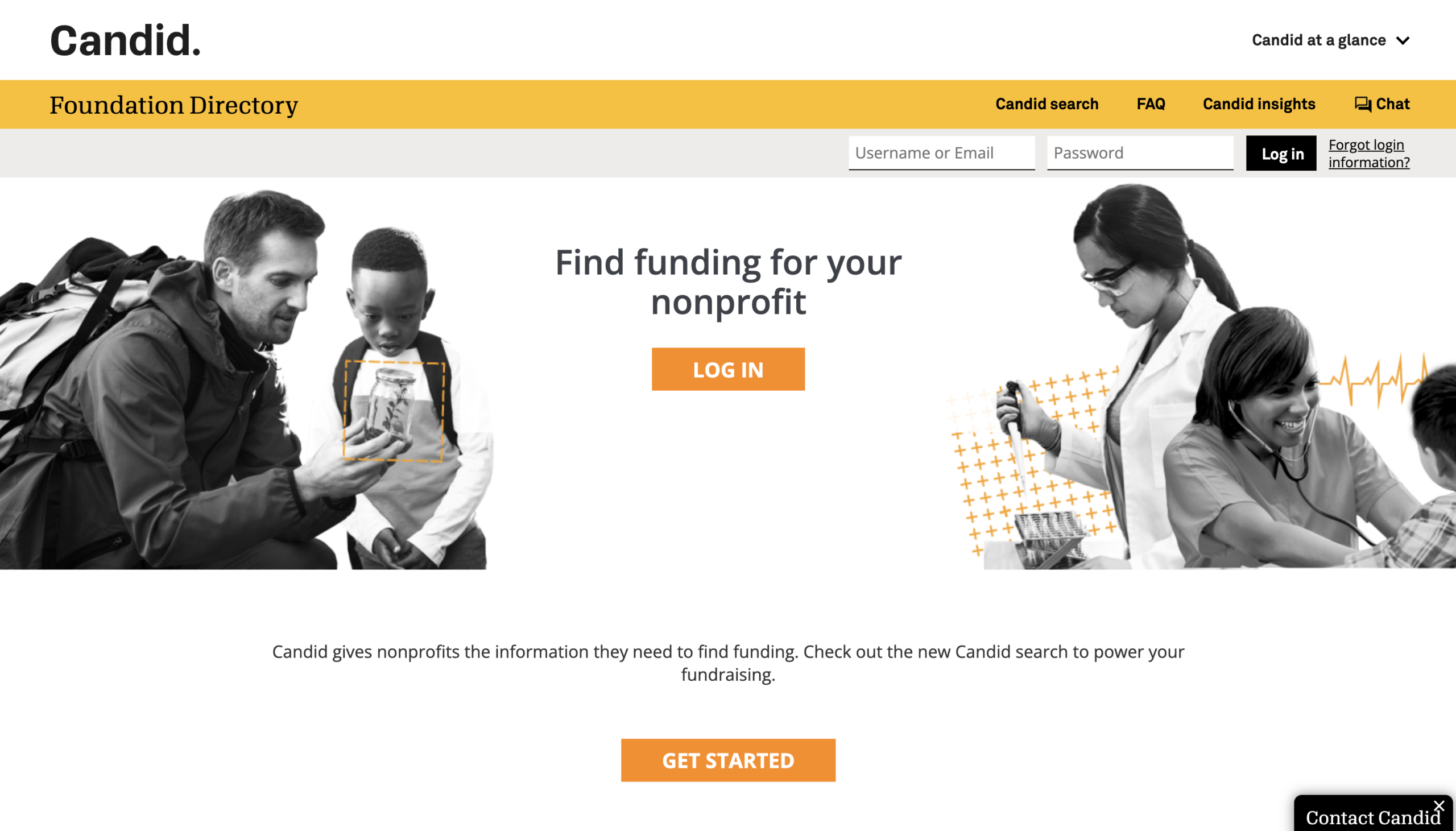
The Foundation Directory Online website homepage

Foundation Directory Online is a comprehensive research database that offers deep insights into US foundations, including their total assets, grant-making history, and board of trustee compositions.

Best For: B2B vendors and consultancies targeting private, family, and corporate foundations with massive grant assets.

Why We Picked It: While primarily used by fundraisers to find grants, B2B vendors selling high-end consulting, wealth management, asset management, or specialized foundation management software can use FDO to locate well-capitalized foundations. It allows reps to inspect total foundation assets, grant payout amounts, and board trustee compositions.

Key Features for B2B Sellers:

  • Comprehensive database covering over 240,000 US foundations and corporate giving programs.
  • Granular breakdown of foundation asset size, annual distribution amounts, and historical grant recipients.
  • Trustee and officer directory listing key decision-makers and board members.

Pros:

  • Unmatched coverage of high-asset foundations and philanthropic grantmakers.
  • Excellent for qualifying account wealth and investment capacity.

Cons:

  • Built strictly around grant research; lacks direct sales outreach integration and direct-dial contacts.
  • Can be expensive for boutique vendors not focused exclusively on grantmaking accounts.

Pricing: Essential plans start around $179/month, with full Professional access costing higher. Many public libraries provide free on-site access to the database.

How B2B Sellers Can Convert Nonprofit Accounts

Selling to nonprofits requires moving past standard commercial tactics. Because purchases depend on board oversight, strict budget cycles, and committee consensus, closing deals requires targeting the right decision-makers, leveraging financial data, and navigating multi-stakeholder buying processes.

Using 990 Contractor Data for Competitor Displacement

One of the most effective outbound strategies for selling to nonprofits is auditing Schedule O and Part VII of an account’s Form 990 filing. Nonprofits are required by law to list their top five highest-paid independent contractors receiving over $100,000 annually.

Tip: Use platforms like Fuller Focus to filter for target accounts paying your direct competitors for IT, legal, auditing, or fundraising services. When reaching out, reference their current spend and pitch your solution as a way to deliver a stronger ROI, upgrade their tech, or cut administrative overhead.

Pitching to the Right Decision-Maker

Pitching mid-level program managers at a nonprofit often results in stalled deals because they rarely have discretionary budget authority.

Tip: Target executives who hold fiscal responsibility and board accountability:

  • Executive Directors/CEOs: Best for high-level strategic software, major agency partnerships, and organizational pivots.
  • CFOs/Finance Directors: Best for accounting software, audit services, payroll, and cost-reduction technologies.
  • Chief Development Officers (CDOs): Best for fundraising software, donor databases, event management, and donor marketing services.

Navigating the Multi-Stakeholder Nonprofits Buying Cycle

Unlike commercial companies, where a VP can swipe a credit card to purchase a new SaaS tool, nonprofits operate under strict board oversight and committee-based purchasing structures.

Structure your sales collateral around risk mitigation, compliance, and stewardship. Provide your prospect with a one-pager that clearly demonstrates how your service saves administrative costs, protects donor data, or directly furthers their mission metrics.

Which Database Tool is Right for Your B2B Sales Team? (Summary)

To help you quickly identify the best database tool for your team’s specific needs, budget, and sales goals, use the summary reference table below:
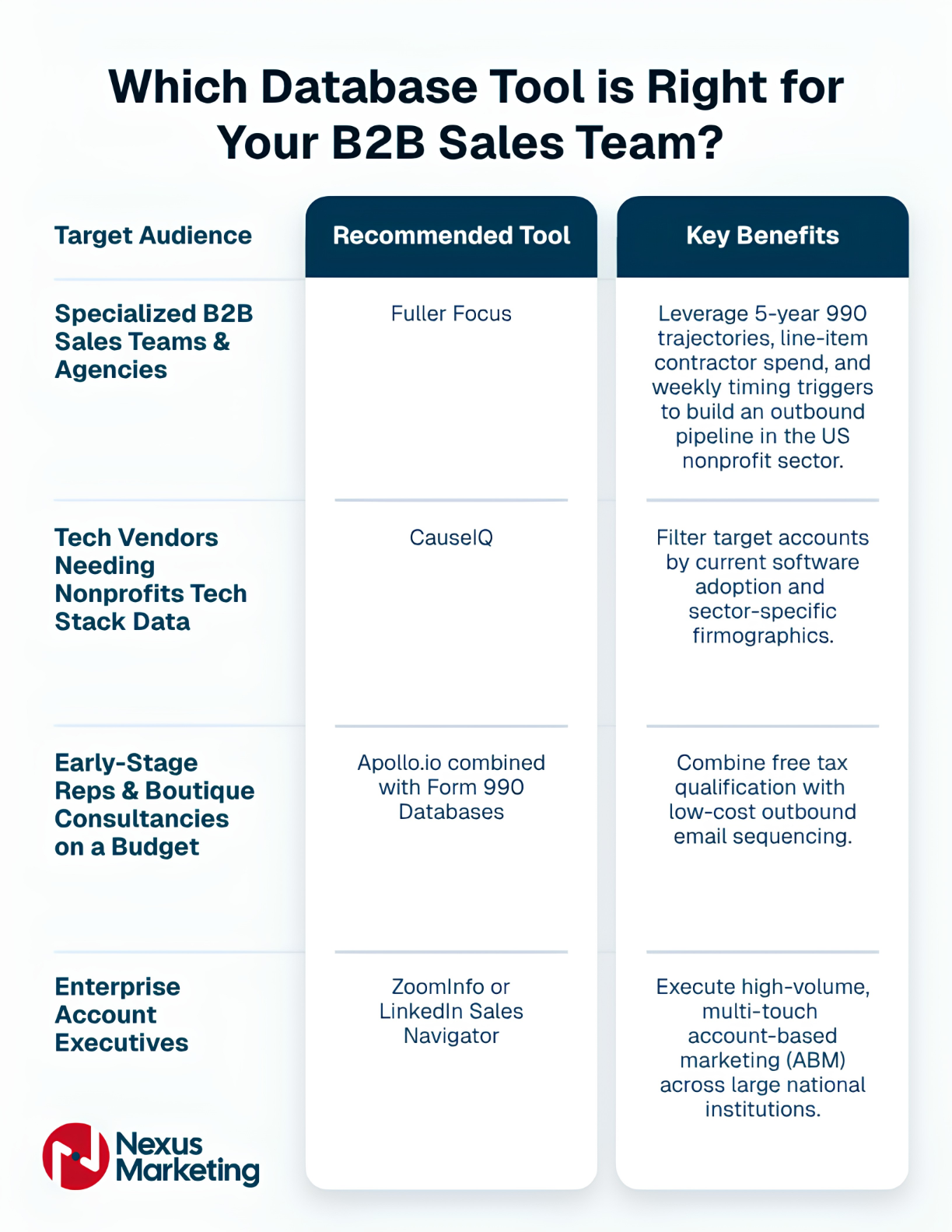
A graphic showing a table outlining which database tool is right for your B2B sales team.

Frequently Asked Questions (FAQs)

Why do traditional B2B commercial sales tactics fall short when selling to nonprofits?

Traditional sales approaches focus on commercial expansion and rapid market dominance. Nonprofits prioritize fiduciary stewardship, sound management, mission alignment, and board transparency. Presenting solutions focused on value, risk reduction, and stewardship builds strong trust and aligns smoothly with committee decision-making cycles.

What financial metrics should B2B reps check before pitching a nonprofit?

Reps should evaluate multi-year trends in Total Contribution Revenue, Net Asset Reserves, and Functional Expense Ratios (Program vs. Administrative/Fundraising spend). An account with growing net assets and stable contribution trends has the financial capacity to invest in long-term technology and consulting services.

How do you find out who currently handles IT, legal, or fundraising for a target nonprofit?

You can look directly at Part VII of the organization’s Form 990 tax return (or use automated platforms like Fuller Focus) to view the top five independent contractors paid over $100,000 annually. This reveals exact vendor names and annual contract values for displacement pitches.

How can B2B reps keep their CRM clean when importing nonprofit prospect lists?

Nonprofit organization names often differ between tax databases and public branding (e.g., legal entity name vs. “Doing Business As” name). Ensure your list-building tool includes verified Employer Identification Numbers (EINs) to deduplicate records in your CRM (like Salesforce or HubSpot) before launching outbound campaigns.

Is cold email outreach legal and effective when prospecting nonprofit executives?

Yes, B2B cold email is legal, provided it complies with the CAN-SPAM and GDPR/CCPA regulations (including a clear unsubscribe link and a physical business address). Because nonprofit executives are inundated with generic sales emails, highly personalized outreach referencing their recent 990 growth or grant awards yields significantly higher response rates.

Wrapping Up

To succeed with selling your products and services to nonprofits, move beyond generic sales pitches and focus on their specific financial health and funding priorities. Use specialized tools like Fuller Focus to uncover accurate budget data and contractor details, so you can tailor your message to their actual needs rather than guessing. By targeting key decision-makers with a focus on cost savings and mission alignment, you can position your services as an essential partnership.
Beyond A/B Testing: Practical Conversion Rate Optimization Strategies for Low-Traffic Sites

Conversion rate optimization (CRO) is a data-driven process of continuously improving interfaces and experiences to turn more website or app visits into customers. In other words, maximizing the value of your site’s traffic.

Often, CRO is mistaken as being synonymous with A/B testing. Or, businesses might think that CRO requires tightly constricting all possible user actions on a page. Even more businesses think that CRO is a one-time practice that can be done via “quick hacks” from blogs, ebooks, or podcasts.

These aren’t bad starting points for exploring CRO for your business! However, it’s limiting to think that CRO is just about testing, and risky to expect that one-time hacks will drive up your revenue.

We offer CRO services and data-driven, iterative optimization practices that drive scaling value — but if you’re new to CRO, concerned about its effectiveness for smaller brands, or curious about first steps, where do you start?

This quick guide explores CRO and tactical ways to build an ongoing optimization practice for your business, even if you receive relatively low traffic volumes. We’ll cover:

  • The Basics of CRO
  • The Challenge of Sample Size
  • 5 Steps for Low-Traffic CRO

The Basics of CRO

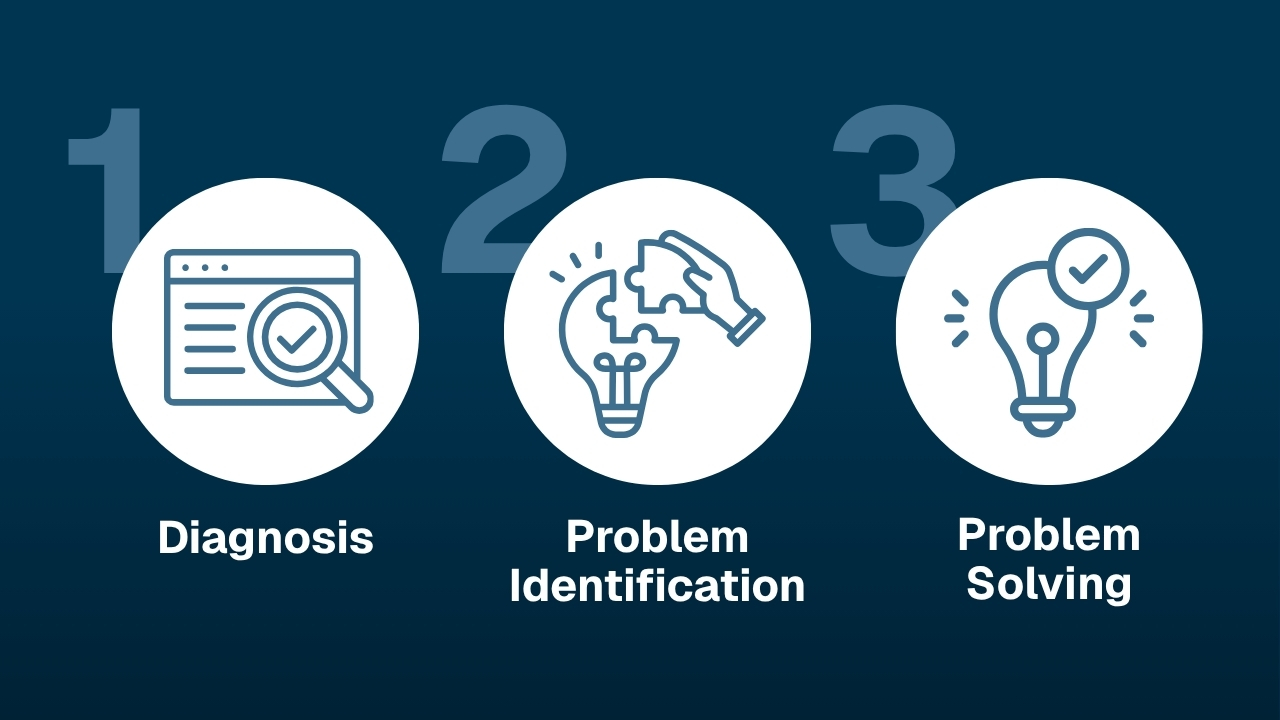
Regardless of whether you’re working with an agency or doing CRO in-house, the core CRO process will include three basic steps:

Key CRO steps

  1. Diagnosis
  2. Problem identification
  3. Problem solving

Depending on who you consult, there could be many variations in how these three basic steps are executed. But, in essence, it all comes down to understanding what’s happening on your website based on the data you see, defining the problem you need to solve to help visitors (and prospects) complete the expected action, and then finding a solution to that problem.

Here’s a closer look at each step:

  • Diagnosis
    • It’s difficult (and not recommended) to optimize blindly, so this crucial first step involves making sense of the data you have within reach — analytics, heatmaps, session recordings, CRM data, etc. As much as possible, use at least two data points to help you build a better understanding of what, how, or why things are happening.
    • Look for patterns and, following Twyman’s Law, be skeptical of any good, interesting, or different data you see. “Any figure that looks interesting or different is usually wrong.”
    • Go through the website as if you’re a customer trying to solve a problem or find information. Compare the real journey to how the UX was designed and how actual users engage with the site during session recordings. Was there a striking difference?
  • Problem Identification
    • From your diagnosis, list down all the difficulties and issues you encountered. Are there issues that can be segmented together, pointing to root problems? Is it a functional problem with the site or a clarity problem with the layout, language, or design?
    • When you identify a problem, also categorize whether or not it’s something that must be fixed immediately (like functional issues or incorrect information) or something that should be tested. This will help you prioritize the actions you need to take.
    • Remember that some tests can’t happen concurrently without diluting the other running experiments and that immediate fixes would still take up web development resources, so plan accordingly.
  • Problem Solving
    • The most common way businesses solve a concern is by immediately shipping out a change or testing a potential solution first. This step is the reason people most often confuse CRO with A/B testing, since these tests are a common method for identifying best-fit solutions to identified problems.
    • Regardless of how you want to approach your problem solving, be sure to tag the changes made and/or ideas tested based on their purposes. Document all key learnings from them. This way, you’ll get a sense of the direction you’re going for and you’ll always gain something actionable even if the test ultimately fails to solve that specific problem.

The Challenge of Sample Size

These three basic steps are easier to put into action on a website with a decent amount of traffic. This is because more traffic makes it easier to establish patterns, test ideas, and confidently say that a change did or did not make an impact.

What if you’re concerned 

For niche businesses, including mission-driven B2B brands, average monthly traffic is likely quite lower than what a medium to large B2C brand might see. And for any smaller brand, site traffic is expensive and can be a luxury.

You might not have the budget to pull in more people to your site through paid campaigns, or you could be relying solely on organic efforts, which still costs money and resources to support.

Unfortunately, for a standard fixed horizon A/B test to be trustworthy, it needs enough traffic volume to achieve statistically significant and high confidence results. Here’s a quick illustration of why this is the case:

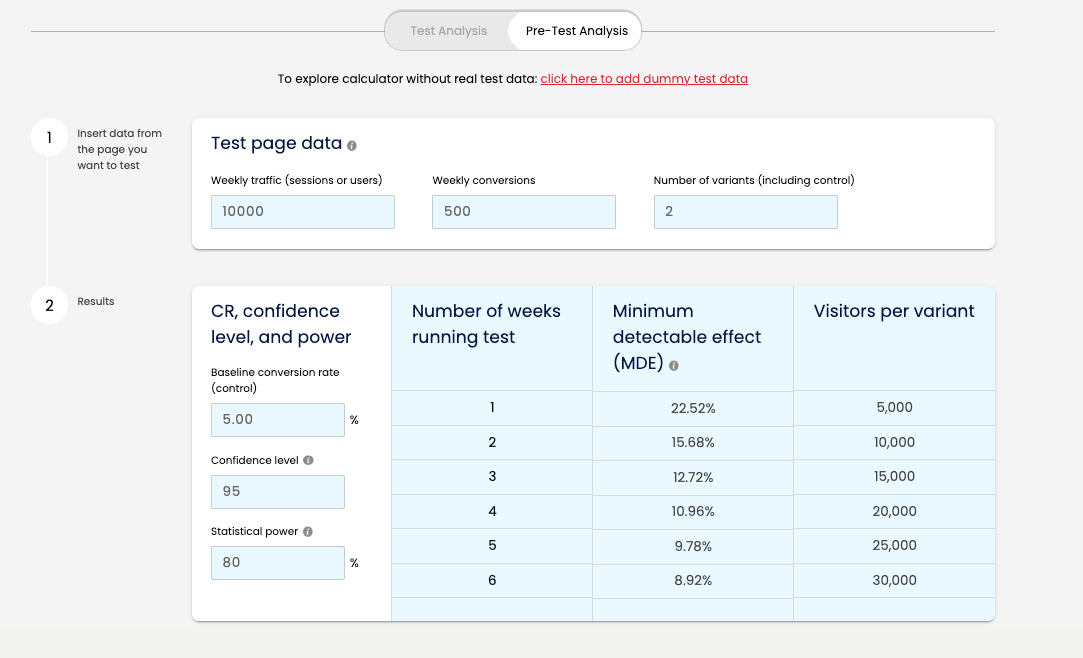
Example A: Pre-test analysis with an ideal test page (enough traffic to get statistically significant and high-confidence results within 6 to 8 weeks)

Example high-traffic A/B test

Minimum detectable effect (MDE) estimations tells us how much impact our tested page variation needs to have to get a significant result. It essentially represents the size of the improvement your new page variant needs to achieve for you to mathematically prove it was the cause of the success. Commonly, this should be less than 20% depending on the scale of the change you plan to run through a 6- to 8-week test.

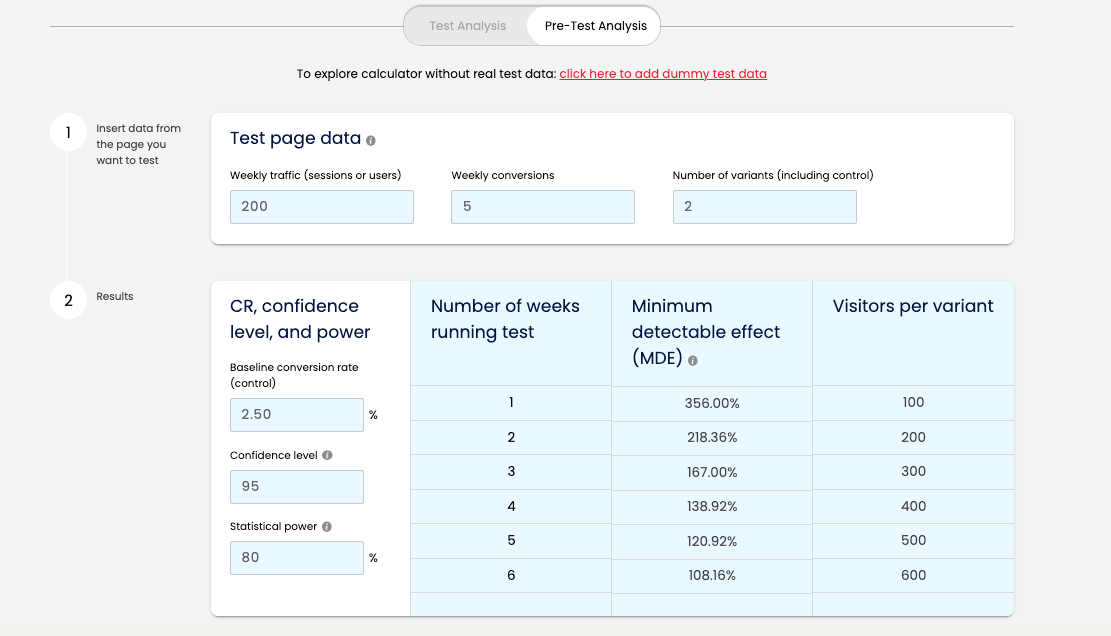
Example B: Pre-test analysis from a low-traffic web page tells us it’s not viable to do an A/B test based on the MDE and the duration.

Example low-traffic A/B test

In this case, the MDE is too high and would risk generating false negative or false positive results.

But while it’s more challenging to execute the core steps of CRO for a low traffic website, that doesn’t mean low-traffic sites can’t do CRO. The best time to do CRO isn’t when you have the traffic, but as early as you possibly can.

Building a high-converting site can pay dividends as your traffic grows over time. 

Think of it this way: Waiting until you’ve already grown your traffic to start optimizing means you’ve likely left a ton of conversions and value on the table along the way. It’s possible to adapt your approach to your current circumstances and iterate as you go.

In the CRO space, the standard rule of thumb for minimum monthly traffic is around 20k-40k sessions per month to yield high-confidence test results.

However, we’ve found 10k sessions per month to be feasible and still drive meaningful benefits when paired with a tailored approach.

The B2B High-Value Factor

When starting with CRO, it’s helpful to remember the outsize impact that improvements can make for B2B businesses.

Remember, you aren’t chasing millions of clicks.

If you have low traffic but high contract values, a single extra conversion from the five ideal buyers visiting your site this month could completely fund your marketing budget for the quarter. Every single visitor can count exponentially more.

CRO services from the mission-driven experts at Nexus Marketing

5 Steps for Low-Traffic CRO

1. Understand your data.

You don’t need a sophisticated tool to start your CRO analysis.

If all you have is Google Analytics, a heatmap tool like MS Clarity (which is free!), and a spreadsheet with all your leads, start with those data sources. You’ll just need to understand how they relate to each other because they have different data collection methods and purposes.

With your available data, try these steps:

  1. Take an overall website health assessment.
  2. Look for the top 3 pages with the most traffic, and where most of the traffic is coming from — referral, organic, email, etc.
  3. Consider any nuances with intent and behavior. Why these pages, and why these sources? This will help you more effectively analyze your MS Clarity session recordings and heatmap data and look for patterns.
  4. Note any expected and unexpected behaviors in your MS Clarity data. Then, determine how your observations could be shaping the number and quality of leads that you currently see from these pages.

2. Talk to your customers.

This is the most direct way to get feedback, and the insights can be invaluable.

One of the best data points to collect is what almost stopped customers from doing business with you. If a pattern emerges, add it to the problems identified and find a way to solve it.

Here are three questions that can help reveal the reasons prospects aren’t converting:

  • “What persuaded you to purchase from us?” — This reveals your strongest message and brand characteristics.
  • “Which other brands or options did you consider before finally choosing us?” — This reveals your true competitors. Your perceived competitors might be different from a consumer’s perspective, so this becomes an opportunity to review (but not copy) what they’re doing.
  • “What almost stopped you from buying our services or product?” — This reveals the biggest friction point that customers actually encountered in their journey.

If directly asking your customers is challenging, make the most out of your sales and any client-facing teams. They talk directly to your customers and have firsthand experience of their confusions and frustration points.

Document all the identified pain points along with how your team usually counters them to still close the sale or appease the client. These pieces of information are incredibly valuable for improving copywriting and clarity on your site.

3. Explore alternative and non-A/B test designs.

Testing a solution is thankfully not limited to just A/B tests — if it were, CRO might be impossible for low-traffic sites.

However, there are plenty of alternative data collection and testing methods that can work for lower-traffic sites.

Other common approaches to CRO for low traffic sites are user testing, surveys, focus group discussions, and method marketing. These can all help you learn more about your clients and their buying journeys straight from the source.

If you’re still keen to conduct technical testing despite low traffic volume, you have options. I explored this topic in-depth for Experiment Nation in this presentation:

To summarize a few of the most actionable routes you could take to run CRO tests on a low-traffic site:

  • Limited A/B tests constrained to upper level conversions or key events. Measuring your test based on form starts instead of form completions will likely increase the volume and power you have. This could be helpful for low traffic sites that follow a multi-step conversion funnel.
  • Before and after testing. This approach allows you to ship changes based on your problem-solving idea while using your pre-existing data as the baseline. You’ll see the difference between the experiment results and what you’d expect using CUPED analysis (a statistical method that filters out background noise to show true performance). Just be ready with a backup of the old page in case something goes wrong so it’s easy to switch back.
  • Go-for-it or do-no-harm tests. This is probably the most straightforward CRO test for any site. The experiment design assumes that there is really no downside in doing the test and there is no detrimental effect if you lose. In using this as your experiment design, you simply calculate your sample size and test duration then decide based on raw conversions rather than the typical conversion rate

4. Set up guardrails.

Guardrails are metrics that act as protective boundaries or early warning systems to your test. This will tell you when it’s time to pause or stop and redesign the test because you’re doing more harm than good to your user experience or backend performance.

Sample guardrails could be exit rates should not exceed 80% in doing this test or page load time should not slow down to 10 seconds. If you hit your guardrail metric, pause and rethink your approach.

5. Don’t stop testing and learning.

Because you’re running on low traffic volume, it’s difficult to be sure that the results you get from tests are truly repeatable. Even after you have completed a test and decided that it made a positive impact enough to make the changes permanent, always monitor the performance.

Repeat the test setup as needed to help you make more strategic decisions. More importantly, document your learnings. It’s possible to see a different outcome over time, so it’s vital to know what made the test perform that way.

Whether a test shows positive or negative results, there is always something to learn to inform your business strategy and decisions.


At the end of the day, our goal is to find the middle ground between what your business wants to achieve and the problems your customers want to solve or a pain they want to alleviate.

Your traffic volume should never stop you from improving your website and overall experiences to serve customers better. You just need to be more creative with how you approach it.

Need help with your conversion rate optimization program? Nexus Marketing offers CRO services focused on helping mission-driven brands that serve niche audiences (and often see lower-than-average traffic volumes) turn more of their website traffic into actual leads and sales.

Ask us how we’d approach your website’s CRO program, and we can provide some preliminary observations and recommendations.

Already a Nexus client? Reach out to your account team to learn more about our CRO services.

Happy optimizing!

CRO services from the mission-driven experts at Nexus Marketing


About the Author

Carla Quizon, CRO Lead, Nexus Marketing

Former Head of Client Success Management and CRO at a performance marketing agency, Carla democratizes conversion rate optimization for B2B websites with specialized ICPs and lower traffic. Over the last five years, she has been developing frameworks that prove smaller organizations can also leverage professional data-driven experimentation to inform their strategies.

Why LinkedIn & YouTube are Key to Winning in AI Search

The way mission-driven organizations find professional services is changing fast.

For a long time, the goal was simple: rank on the first page of Google for the right keywords. While that still matters, we’re seeing a clear shift toward Generative Engine Optimization (GEO).

Today, your brand needs to do more than show up in a list of links; it needs to be the answer that AI engines like ChatGPT, Gemini, and Perplexity recommend directly to their users. How?

Becoming an authority trusted by LLMs requires a broader digital footprint than a standard blog can provide. AI models look for consensus across the web to learn who the real experts are.

To win in this new environment, your brand needs a coordinated, multichannel strategy. Here’s what we’ll cover in this crash course:

  • Why AI Engines Crave Multichannel Content
  • The Platforms Driving AI Citations
    • LinkedIn
    • YouTube
  • Bridging the Multichannel Gap
  • The Nexus Approach

Why AI Engines Crave Multichannel Content

Large Language Models (LLMs) like ChatGPT Search, Claude, and Google’s AI mode behave differently than traditional search engines.

They’re designed to summarize and recommend the most credible “entities” in any given space. When your brand only exists on your own website, you’re providing a single data point. AI models typically require multiple, consistent signals across different platforms to verify that your brand is a trusted authority.

This is where multichannel content becomes your strongest competitive advantage.

By appearing on LinkedIn, YouTube, and other high-authority domains, you train these AI models to recognize your expertise. And the more places your original thought leadership appears, the higher the confidence score the AI assigns to your brand.

The Platforms Driving AI Citations

AI models do not treat all websites equally. They prioritize platforms where original, human-led discussions take place.

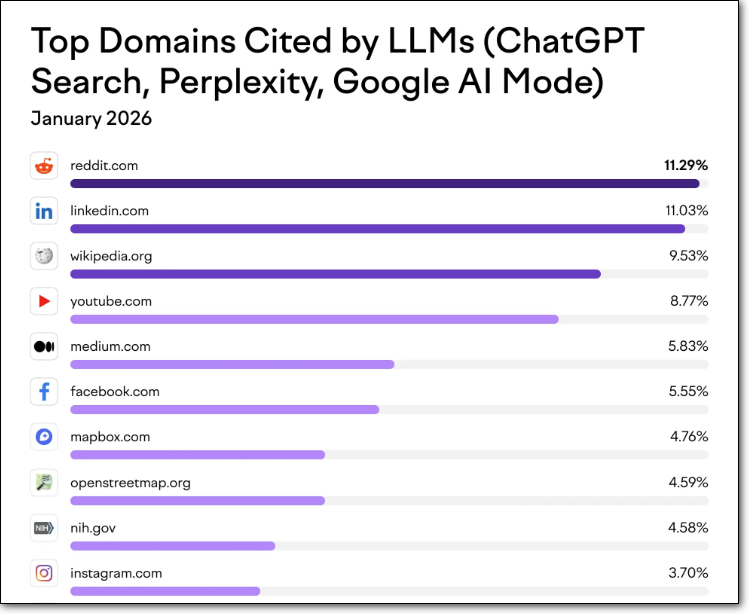
According to 2026 data from Semrush, a few specific domains dominate the citation landscape:

Top cited sources for LLMs

  • Reddit.com: 11.29% citation rate
  • LinkedIn.com: 11.03% citation rate
  • YouTube.com: 8.77% citation rate

If your marketing strategy ignores owned external channels like these, you’re essentially invisible to the engines that organizations are using to make buying decisions.

Reddit can be challenging to master at scale and can be less impactful for some B2B brands than others. Your presence on LinkedIn and YouTube, however, is entirely within your control and can play important roles in B2B buying decisions.

LinkedIn: Establishing Professional Authority

LinkedIn is currently one of the most important channels for training AI on your B2B brand identity. However, the AI engines can be very selective about what they choose to cite from the platform:

The Importance of Originality

Data shows that roughly 95% of LinkedIn citations across ChatGPT Search, Perplexity, and Google AI come from original posts. Reshared content is almost never recommended by AI. To be cited, your brand must lead the conversation with its own unique insights.

Action items:

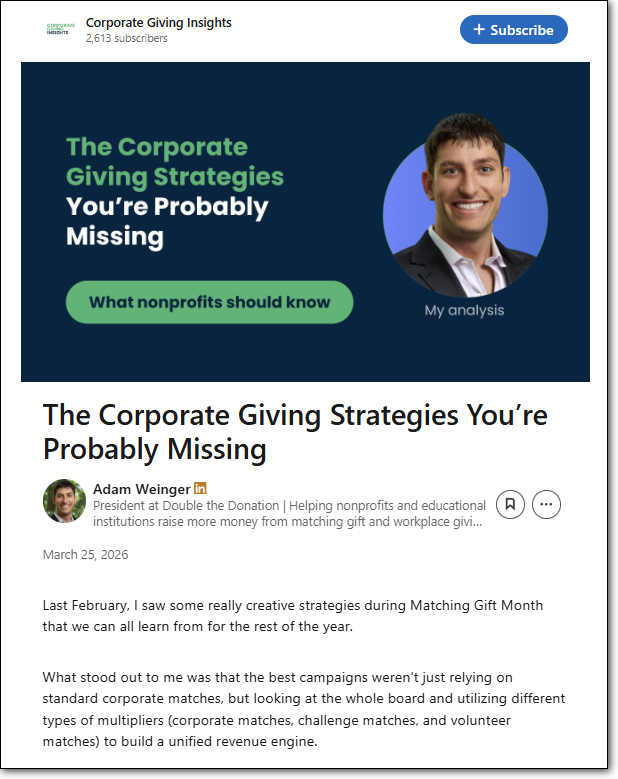
  • Create a LinkedIn newsletter for your brand or post Pulse articles.
  • To save time and reinforce your messaging, consider repurposing new or existing thought leadership (like reports, op-eds, and high-value blog content) into new versions for LinkedIn.

Example LinkedIn Pulse article

Posting Consistently

The most frequently cited pages on LinkedIn typically post five or more times per month. This steady flow of content provides the “freshness” signals that AI models use to determine which brands are active industry leaders.

Action items:

  • Establish a consistent publishing cadence, aiming for 5+ posts per month.
  • Try to create a mix of long-form thought leadership content, infographics, text posts, and occasional reshares of content from leadership, employees, and other organizations.

YouTube: Building Multimodal Trust

YouTube serves as a multimodal anchor for your brand’s visibility.

AI engines do more than just index the video title; they crawl high-fidelity transcripts to understand the depth of your expertise. By hosting webinars or sharing expert-led video guides, you provide structured data that AI models can easily summarize and cite.

This creates a powerful cross-reference signal. When an AI finds your insights in a whitepaper, on a LinkedIn article, and in a YouTube video, it confirms your status as a multichannel authority.

Action items:

  • Determine the lowest-friction ways to begin producing video content for your brand.
  • If you already produce webinars, consider posting them on YouTube, and be sure to use optimized titles and descriptions that clearly explain the content and why it’s valuable.
  • Repurpose webinars into shortform clips of key insights that can be posted as YouTube Shorts and on LinkedIn.
  • If possible, begin producing net-new video content for YouTube and your website, or partner with an agency (like Nexus). Even simple talking head footage with basic titles, graphics, and animation can make an impact.

Bridging the Multichannel Gap

Many brands struggle with establishing expertise across channels. This happens when a company has strong technical SEO and a functional sales machine, but lacks the fresh thought leadership that AI engines need to see.

Without a dynamic presence across multiple channels, your brand can feel static or outdated to an AI crawler.

Multichannel content—such as LinkedIn articles and carousels, educational videos, reports, interactive infographics, and more—ensures that your brand remains relevant and recommendable as the search landscape evolves.

The Nexus Approach: AI Signal Coverage Campaigns

We help our partners move beyond scattershot marketing and toward a centralized content system that builds credibility with both LLMs and your potential leads.

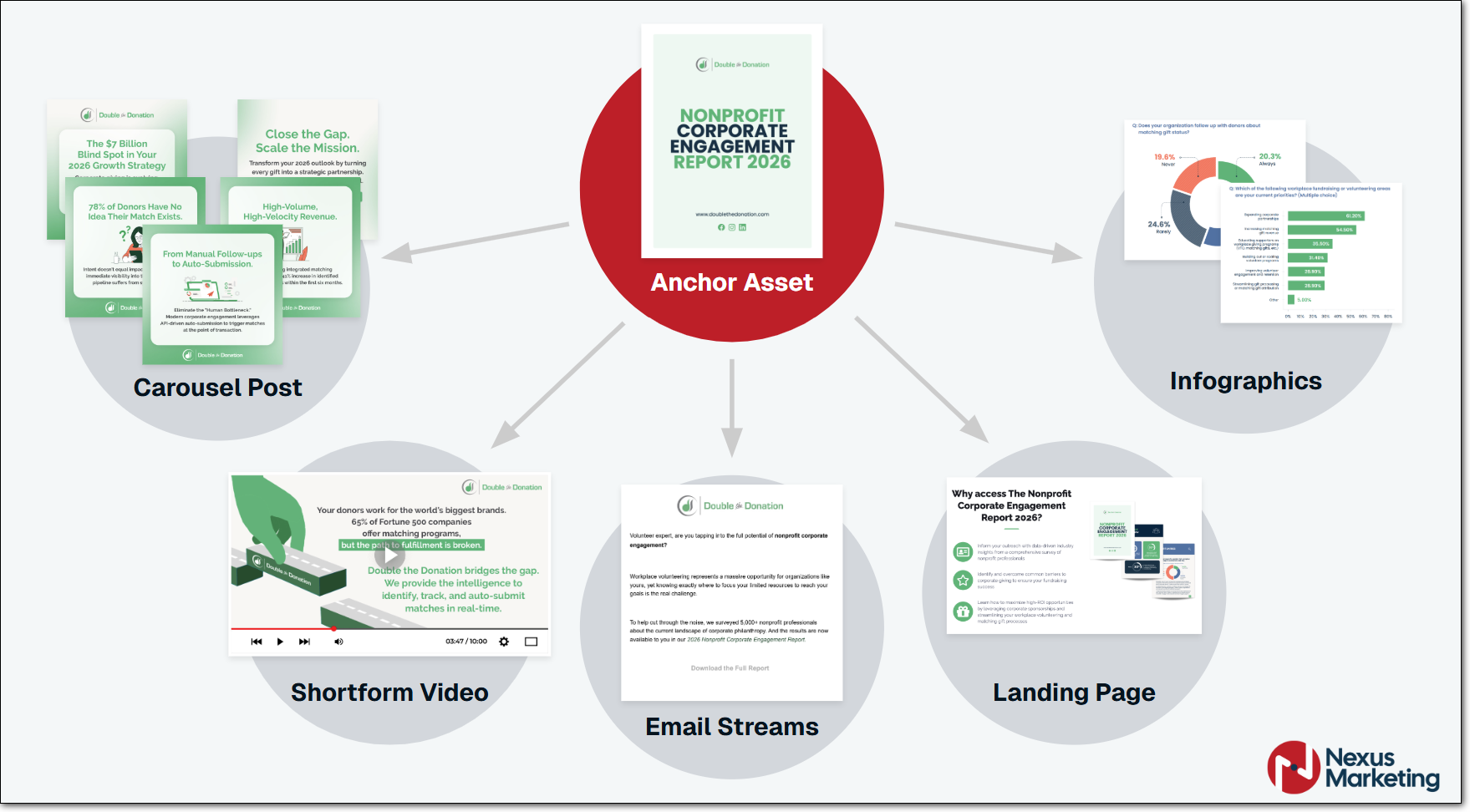
Our strategy uses a syndication model to build sustained authority:

Example content syndication system

  • Anchor Assets: We start with a high-value piece of proprietary thought leadership content, like a custom industry report, an SME interview, or a produced webinar.
  • The Content System: We then syndicate that anchor into a suite of related assets, including LinkedIn Pulse articles, email streams, and short-form videos.
  • Building Momentum: This steady flow of cohesive content empowers your team to close deals faster while training AI models to recommend your brand.

The shift toward AI-driven search is a major opportunity for brands that are ready to lead. By focusing on original, multichannel authority, you can ensure your brand is the one being recommended by the engines of the future.


Curious how we can support your multichannel goals?

Contact us or reach out to your Nexus account team — we can compile custom recommendations, competitor analyses, and examples to show you what this strategy would look like in action for your brand.

If you’re already a Nexus client, we can also identify ways to integrate multichannel AI signal coverage into your current monthly activities.

Nexus Marketing can build winning content campaigns to help you close more deals - contact us