A user does a quick Google search for a program or service that your nonprofit provides.
What if your nonprofit was the very first thing they see?
Search engine optimization (SEO) isn’t just for big for-profit brands—any organization that depends on reaching online audiences to promote its programs, services, and products can benefit from an SEO strategy.
Yes, that includes nonprofit organizations! In 2023, NP Tech for Good found that just 37% of nonprofits have dedicated SEO strategies. Considering the long-term value that effective SEO generates, this is a huge missed opportunity for the sector and communities around the world.
SEO is completely learnable and built on straightforward technical and marketing concepts. We’ll cover them all here:
Why take our advice? Nexus Marketing has been helping mission-driven brands grow their online visibility and demand generation for a decade now.
In that time, we’ve seen tons of SEO trends come and go. We know the steadfast best practices that drive real, sustained success, and our goal is to help more organizations cut through the clutter and buzz.
What is SEO?
Search engine optimization (SEO) is the process of technically maintaining your website and publishing high-quality, keyword-optimized content to help a website appear higher in organic search engine results.
Within the broader field of SEO, you’ll encounter some more specific practices:
- Technical SEO: The practice of improving and maintaining the technical quality of your website so that it’s easily understood by search engines and provides positive user experiences.
- Keyword strategy: The process of choosing strategically important keywords that your organization wants to rank highly for to achieve its goals.
- Content strategy: The practice of creating and updating high-quality web content optimized for technical performance, keyword relevance, and user experience.
Quick context: Organic search results are any that are not paid ads (like the Google Ads you’re likely used to seeing). Search engine results pages are often called SERPs, which we’ll use in the rest of this guide.
What are the Goals of SEO?
Organizations of all types and sizes use SEO strategies to rank higher for their target keywords. By ranking higher, they can:
- Generate more demand and leads for their programs, services, and products
- Increase traffic and engagement from qualified online audiences
- Grow their organization’s online visibility and brand recognition
Spoiler Alert: Effective, ongoing SEO has a powerful flywheel effect.
In other words, when your website is a trusted source of high-quality content, it’s more likely to rank higher for a wider range of keywords, further growing your visibility (and incoming customers).
Here’s an example: One of our clients ranked highly for 5 keywords at the start of our partnership. They now rank for 187 of their most important keywords—Google was ready to trust and amplify their brand but needed some nudging (and a stream of fresh, high-quality content)!

Why SEO Matters for Nonprofits
SEO is a smart investment for many nonprofit organizations for several reasons. These include:
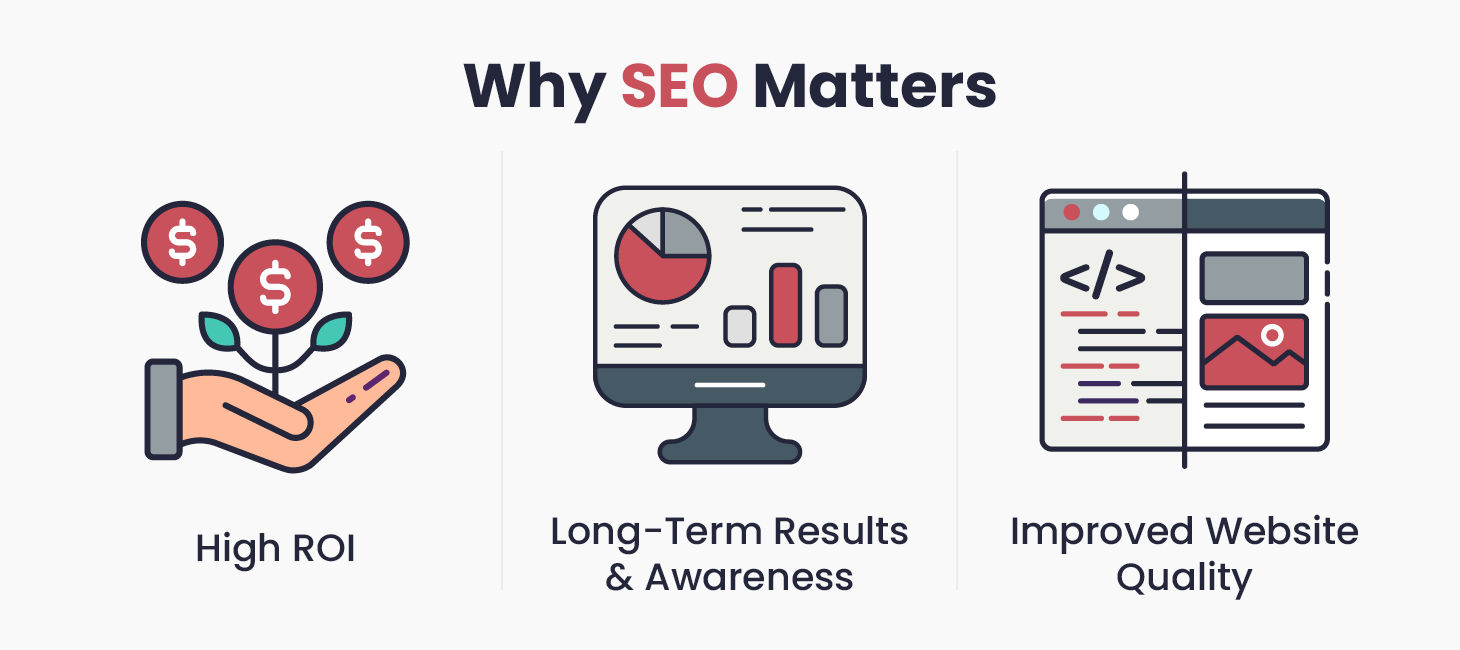
- When done well, it offers a high ROI.
- SEO is relatively low-cost compared to other marketing channels. It’s possible to make big SEO gains for free when you follow best practices, although many organizations partner with SEO agencies to reduce workload and enhance their results.
- Another reason SEO offers such a high ROI is that it allows you to target highly qualified audiences. If someone searches for a niche service or program you offer, SEO ensures your nonprofit reliably appears front and center.
- Compared to pay-per-click online ads, SEO tends to offer the better ROI—between roughly 500% and 1,300%. The results of an effective SEO strategy increase over time, but its fixed costs do not (unless you want to really increase your SEO activities).
- SEO drives long-term results and brand awareness.
- SEO is truly a growth investment. As mentioned above, an effective SEO strategy acts like a flywheel—attracting more attention and achieving higher rankings as your website’s authority grows. This kind of organic growth is a powerful marketing force that will establish your nonprofit as a go-to resource in its field.
- It results in all-around better websites.
- SEO teaches us to be more thoughtful and strategic about how we use our websites as marketing and engagement tools. When you prioritize SEO and follow a robust content strategy, you’ll create a technically polished website and a library of high-quality web content.
- These across-the-board improvements make stellar impressions on visitors, no matter how they found your website. Give them a helpful, positive experience, and they’re more likely to stick around and learn more about your nonprofit’s offerings.
TLDR: Like other mission-driven organizations, nonprofits often have tight or inflexible budgets.
SEO offers a lower-cost, higher-ROI way to drive sustained marketing results and increase brand awareness.
Digital Advertising vs. SEO for Nonprofits?
Organic search SEO is often weighed against paid search ads, with many nonprofits opting to increase their ad spend rather than launch an SEO strategy.
Is there one right option? No, the nonprofit sector and organizations’ revenue streams are too diverse to generalize about optimal strategies.
However, for some types of nonprofits, SEO is a major missed opportunity. It’s an ideal way to build awareness and demand for programs, services, and products that generate revenue. It’s not a great long-term choice for generating fundraising dollars.
We’ve gathered a few salient points from the most recent M+R Benchmarks Report (our favorite source for up-to-date insights on the state of nonprofit digital marketing):
- 44% of site visits to nonprofits in the study came from organic traffic (i.e. not from ads, email, social media, or other channels).
- Nonprofit digital ad spending increased by 13% in 2023.
- Among surveyed nonprofits, 61% of all ad spend was dedicated to direct fundraising. Only 10% went to lead generation.
- The only advertising channel where nonprofits decreased average spend in 2023 was Meta/Facebook.
- The average cost to generate a lead (non-fundraising revenue) through advertising was $3.33.
- Digging deeper by advertising channel, the report found huge variances in cost-per-lead by channel:
- Google/YouTube ads: $14.07 per lead
- Meta ads: $4.44 per lead
- TikTok ads: $49.28 per lead (!)
The story is different for every nonprofit and mix of revenue streams. But looking at those last numbers, it’s clear that for many organizations there are much more cost-effective channels (like SEO) for generating leads. Looking at you, social media ads.
Here’s how the report summed it up:
There remains enormous untapped potential for many nonprofits. Continuing to expand audiences, executing thoughtful strategy, and making every message matter are the keys to growth.”
Essential Points to Remember
There are a few big-picture points to keep in mind to succeed with SEO for your nonprofit. Here are the essential reminders that we often discuss with our SEO clients:
- SEO is a long game. You might see fast results (and we often do), but the biggest impact comes in the months and years after you’ve implemented and maintained an SEO strategy.
- It’s an iterative process. Unlike ads, there’s no need to get your SEO strategy and content 100% perfect the first time! Google constantly recrawls content to check for quality, so you have endless opportunities to study your results and improve.
- Consistency and quality are key. SEO should be an ongoing priority to keep showing Google and readers that your website is worth paying attention to. Especially in the age of AI (more on this later), excellent content written for and by humans will reign supreme.
- Understand your SEO objectives. Strategies derail when you focus on the wrong goals, like web traffic metrics. Search algorithms change constantly, some keywords see highly seasonal traffic patterns, and some keywords are just extremely competitive. There are many reasons why leading metrics will distract you from the real objective—generating leads.
Simply put, demand generation should be the overarching goal of SEO, not leading metrics like web traffic.
A Closer Look at SEO Goals for Nonprofits
For nonprofit organizations specifically, SEO is better for marketing some types of your offerings than others:
When you focus your SEO strategy on scalable, sales-based revenue sources, you create a much clearer path to success. Think of it like this:
- Fundraising is built on building awareness and carefully fostering relationships over time.
- SEO puts your nonprofit front and center when users already know exactly what they’re looking for—a much shorter path to generating revenue.
While SEO can help build awareness of your mission and brand, perhaps eventually leading to donations if you capture users’ attention and contact information, the timeline of this ROI is extremely long. You’re much more likely to receive a donation from someone with a pre-existing relationship with your nonprofit.
But if you offer specific programs, services, and products that generate revenue for your mission, SEO is the key to reaching your target audiences efficiently.
We advise our clients that short-term or fundraising-based goals are better supported with other marketing channels like direct email outreach, paid ads, social media, or specialized local SEO services. In other words, SEO should be an ongoing, foundational marketing activity on which you layer additional channels and campaigns to support specific objectives.
Want an example of how SEO and other marketing strategies play well together? Check out our write-up of the top ways to integrate pay-per-click and SEO campaigns to drive success.
How SEO Works
With the context squared away, let’s get into the nitty-gritty—how does SEO work? How does a page go from unranked to dominating the SERP?
Here’s a condensed rundown of the basics of SEO:
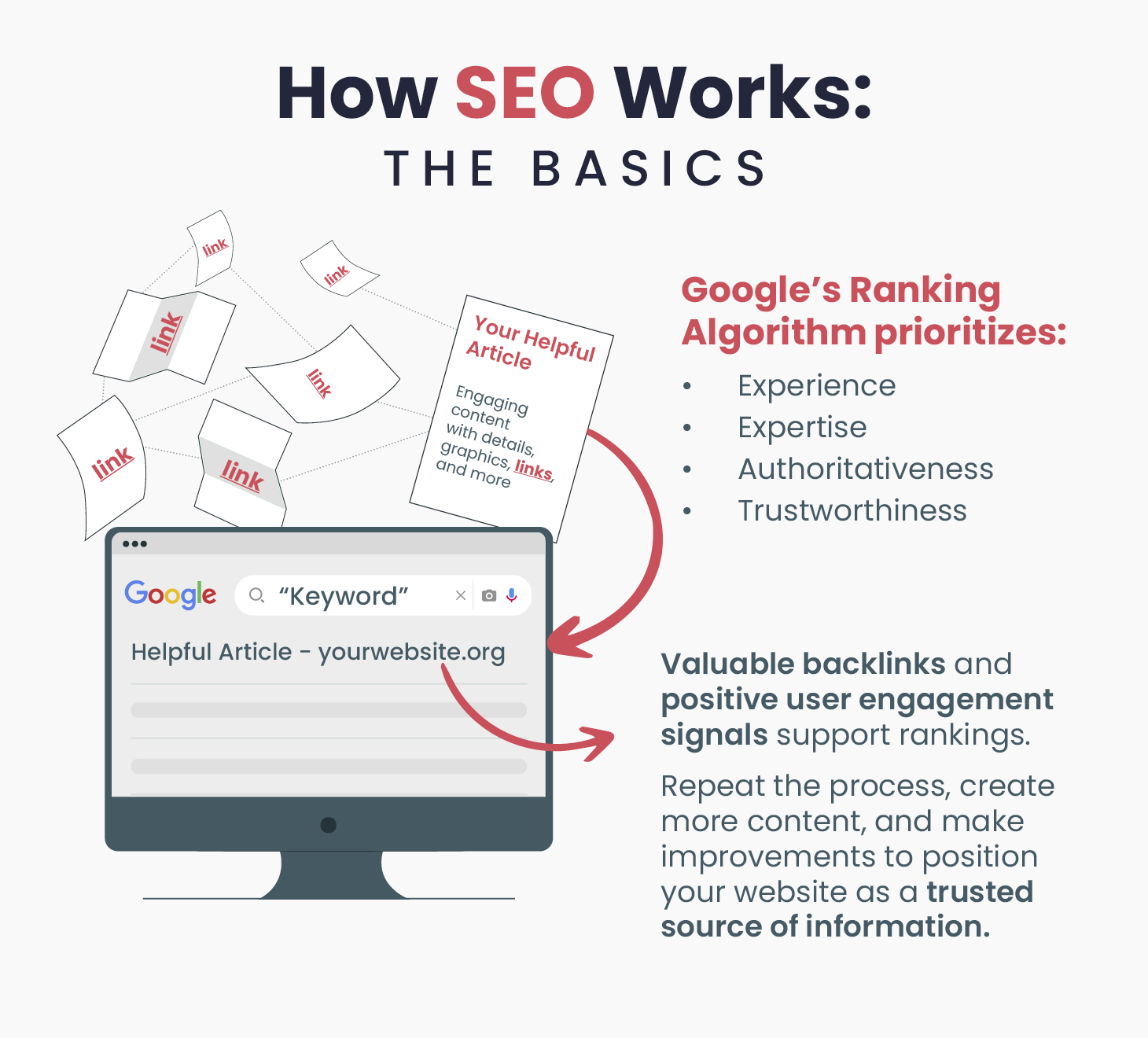
1. Search engines like Google use crawler bots to explore the internet. They screen content, pick up on keywords and concepts, check out the links it includes, and log all of its contextual information as part of its algorithmic ranking system.
This process is called indexing. If a page cannot be indexed, it won’t appear in Google results and is likely the result of a technical issue with your website.
2. Google pays extra attention to links. When one website links to another, Google considers this a kind of vote of confidence, a little stamp of approval that says, “I trust this source enough to show it to my audience.” Over time, pages accrue backlink profiles of all the other pages on the internet that link to them.
3. Pages are analyzed and ranked for EEAT. EEAT stands for Experience, Expertise, Authoritativeness, and Trustworthiness. It’s a helpful shorthand for understanding how Google defines truly “helpful,” rankable content:
-
- Experience. Does the page’s author and/or the website domain have relevant experience with the topic and a history of publishing content about related topics?
- Expertise. Does the content demonstrate actual expertise, i.e. correct information, relevant details, helpful insights, anecdotes, and more?
- Authoritativeness. Does the content have links from other high-quality pages across the internet, and are those links contextually relevant (that is, not spammy)? Does the website publish other helpful content?
- Trustworthiness. Does the website come from a recognized brand, organization, or person? Does it provide transparent contact information? Has it been flagged for improper SEO practices in the past?
There’s some overlap between these concepts, but taken as a whole, they give us a reliable picture of the content Google wants to serve its users.
Extra Context: The Google Algorithm
A combination of algorithmic and human scoring—from real content reviewers—is used to gauge how highly a web page should rank and for which keywords.
Google also uses AI-based natural language processing systems to interpret content and map interrelated concepts, which has allowed it to better understand content quality over time.
Google’s ranking algorithm is notoriously complex and constantly changing, with hundreds of different ranking factors being tweaked, prioritized, and deprioritized over time. Historically, Google has been secretive about the exact makeup of the algorithm, but a recent leak (huge news in the SEO world!) gave us more direct insight into its current ranking factors than ever before.
4. When users search keywords or longer phrases, Google delivers a mix of content. Google makes assumptions about the user’s intent from the keyword—what they’re trying to accomplish with their search—which informs the mix of SERP features that it delivers.
These always include organic results, pages that have organically demonstrated their EEAT to Google. Most SERPs also include pay-per-click (PPC) ads, which are indicated with “Sponsored” taglines.
SERPs usually also include features designed to quickly provide answers and satisfy that particular user intent.
Extra Context: Types of SERP Features
The biggest new SERP features to be aware of are AI Overviews (more on these below), but other common features include:
- Featured Snippets
- Discussions and Forum listings
- Image results
- People Also Ask suggestions
- Product carrousels
- News story carrousels
- Local business listings
- And many, many more
Google scrapes relevant content to populate these SERP features. This is usually an indication of high quality. If your page gets highlighted in a Featured Snippet, you’ll secure even more valuable SERP real estate!
5. User engagement signals impact the ranks over time. Based on how users engage with the results on SERPs, Google’s ranking algorithm refines its inferences and makes adjustments over time.
SERPs never stand still for long. In addition to user engagement signals, rankings can change for all kinds of reasons:
-
- New competing content gets published
- Older content on the SERP gets updated and improved
- Other EEAT signals change (like a page’s number or quality of backlinks)
- Or the Google algorithm gets updated to prioritize a slightly new balance of factors
It’s important to keep track of your SEO performance and identify slippages so that you can make targeted content improvements—we’ll explain this process in the playbook below.
6. Google comes to recognize some domains as more authoritative than others. As a website publishes more high-quality SEO-optimized content and accrues backlinks, Google will recognize that domain as a reliable source of helpful content about its core topics. It then gets prioritized in more SERPs—a powerful flywheel effect that amplifies your SEO success.
To measure a domain’s authoritativeness, SEO professionals use a variety of proprietary metrics. At Nexus Marketing, we’ve long relied on Moz’s Domain Authority score as a rough gauge for how well-established a website is in the eyes of Google.
TLDR: Google constantly screens content for quality, EEAT signals, and backlinks. Content is algorithmically ranked using complex mixes of hundreds of factors, including user engagement metrics.
Over time, Google recognizes domains for high-quality content about their particular topics and prioritizes them to rank for more keywords.
Key Elements of SEO-Optimized Content
Ok, so you understand how Google ranks content. In tactical terms, what are the specific elements that your organization’s content needs to catch Google’s attention? Good question.
The Nexus team spends all day thinking about, researching, and writing SEO-optimized content for our clients and partners. Here are our top recommendations and the specific elements we always include in SEO articles.
Our Top Advice for Creating SEO Content
Our three most important rules of thumb for creating effective SEO content:
- Satisfy the user intent. Understand what users want when they search your target keyword.
- Don’t clutter the content. Answer users’ questions without unnecessary fluff and create a positive experience.
- Offer real value, expertise, or something new—in the AI age, you have to go the extra mile to stand out.
From these tips, you can probably tell that there is no one-size-fits-all SEO content template you can follow for SEO success. Stuffing keywords into a generic article and hitting publish may have worked once upon a time, but those days are long gone.
Users and Google alike want quality content from trustworthy sources. The length, structure, and complexity of your content should be tailored to the audience’s needs. If the keyword calls for a long, educational guide, that’s what you should create. If the keyword calls for very short definitions and quick bits of information about a product or service, create that content.
Elements to Optimize in SEO-Optimized Content
Even though there’s no single template for SEO content, there are specific technical elements that any web content intended to rank should include. The most important of these are:
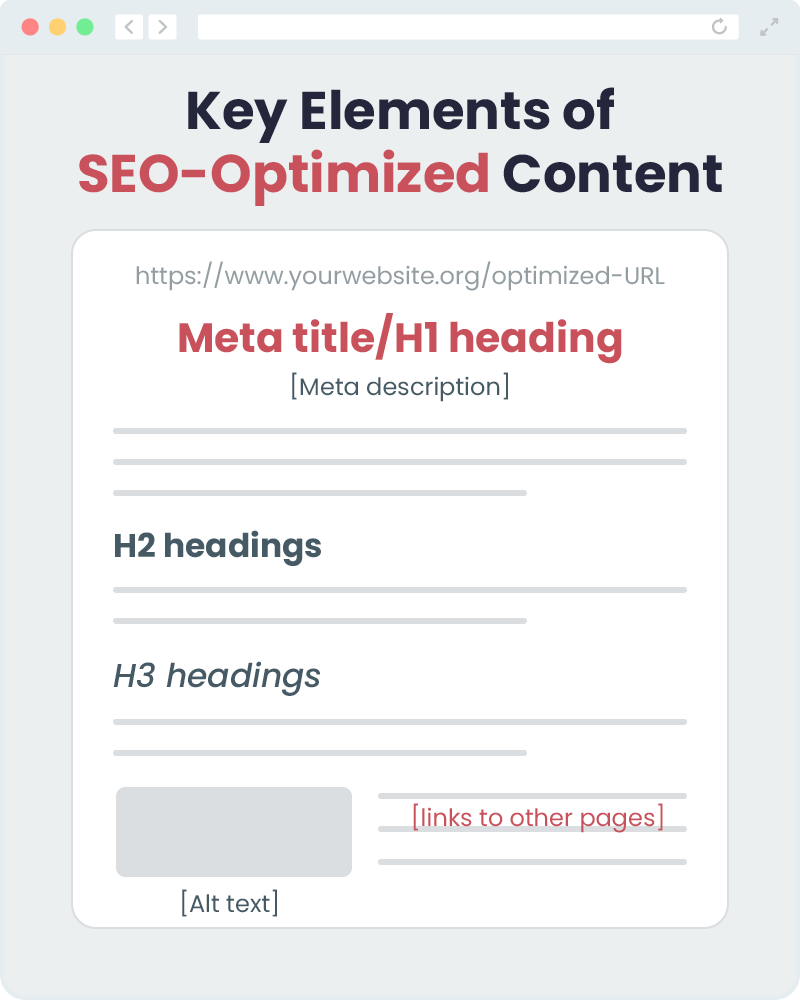
- The page’s meta title and H1 heading (which may not be the same—always worth checking) should include the page’s primary target keyword.
- The page’s meta description, or the short excerpt displayed on SERPs, should include a relevant keyword and entice users to click.
- Other H2 and H3 headings should include a mix of natural keyword variants and organize the content in a logical way.
- An optimized URL that isn’t too long and includes a relevant keyword that Google can quickly recognize.
- Alt text for any graphics included in the content that briefly describes what the graphics represent.
- Content should ideally include links to other relevant content on the same domain and reputable external websites.
- The page’s and website’s design should create positive desktop and mobile viewing experiences.
Want to see these SEO-optimized content elements in action? Look around you! This very page follows SEO best practices for keyword optimization, user experience, and mobile usability.
Or, check out a comprehensive list of all the content tactics and technical elements that we include in SEO-optimized client content in this complete comparison guide.
SEO for Nonprofits in the AI Age
The rise of generative AI has been a seismic shift for the marketing world, and especially for SEO. The introduction of AI Overviews directly in SERPs has probably shaken up the industry more than any other update in decades.
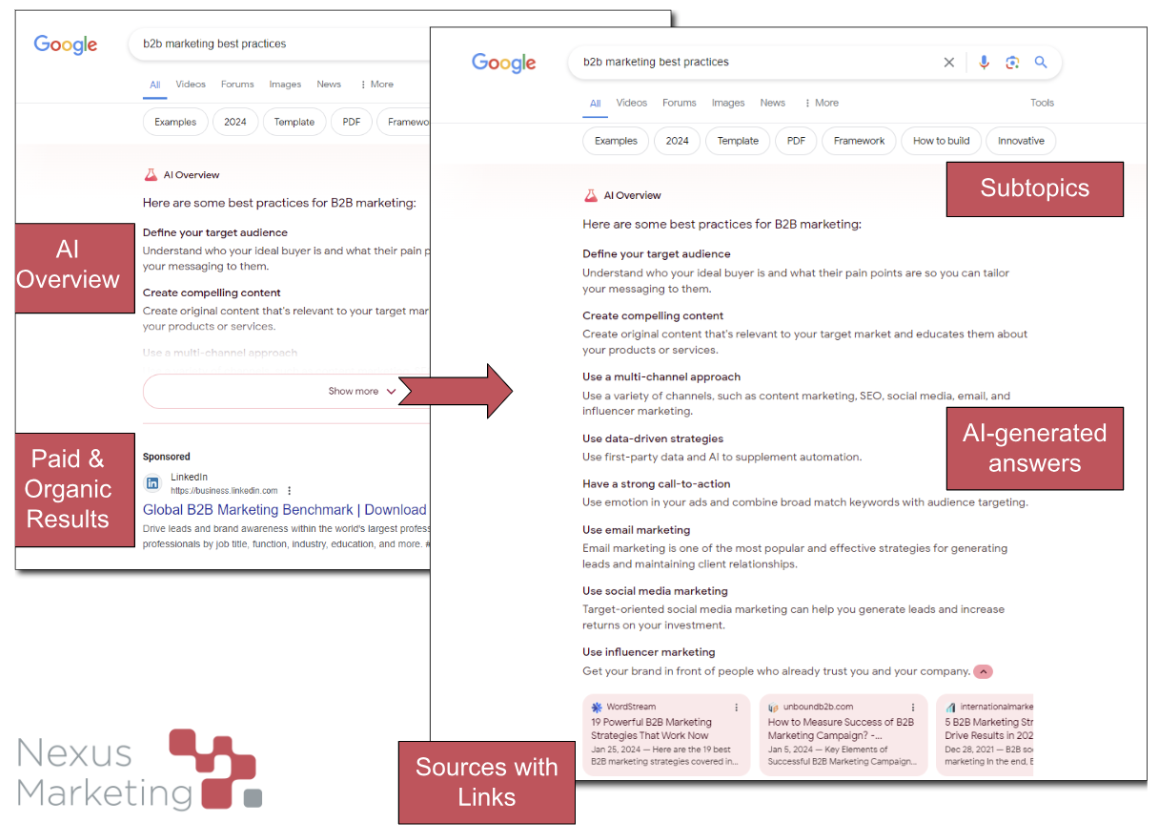
However, anytime you search “AI in [insert industry here]” to learn more, you’re likely to see a slew of dramatic editorials and conflicting claims. It’s the same in the SEO space, and it’s more confusing than helpful for newcomers.
We want to help you cut through that clutter so you can better understand the real, current state of SEO in the AI age before further investing in it for your nonprofit.
We’ve already written a few guides that spell out our positions on the implications of AI on SEO:
Misusing or misunderstanding AI can create all kinds of risks for your nonprofit’s website. If you don’t have time to read these articles, we hope you take away these key points:
- SEO isn’t going anywhere, but it is adapting to a rapidly changing search landscape.
- Do not use AI to fully write website content intended to rank. It will not offer the same value, originality, experience, and human touch that other content will, and Google will know.
- The introduction of AI Overviews on SERPs means that full-funnel content strategies are more important than ever. This means creating content that covers more specific topics and keywords instead of focusing only on those with very high search volume. Remember, attracting truly qualified audiences drives much more value than simply attracting large audiences.
- Try to create “information gain” in your nonprofit’s web content whenever possible. What are the unique insights and positions that only your organization can offer? This is the valuable content that AI will never be able to replicate.
Curious what an AI-savvy SEO strategy would look like for your nonprofit? Get in touch and let’s chat about it.
Your Nonprofit’s First SEO Playbook
Ready to get started? Here are the core steps for launching an SEO strategy for your nonprofit for the first time.
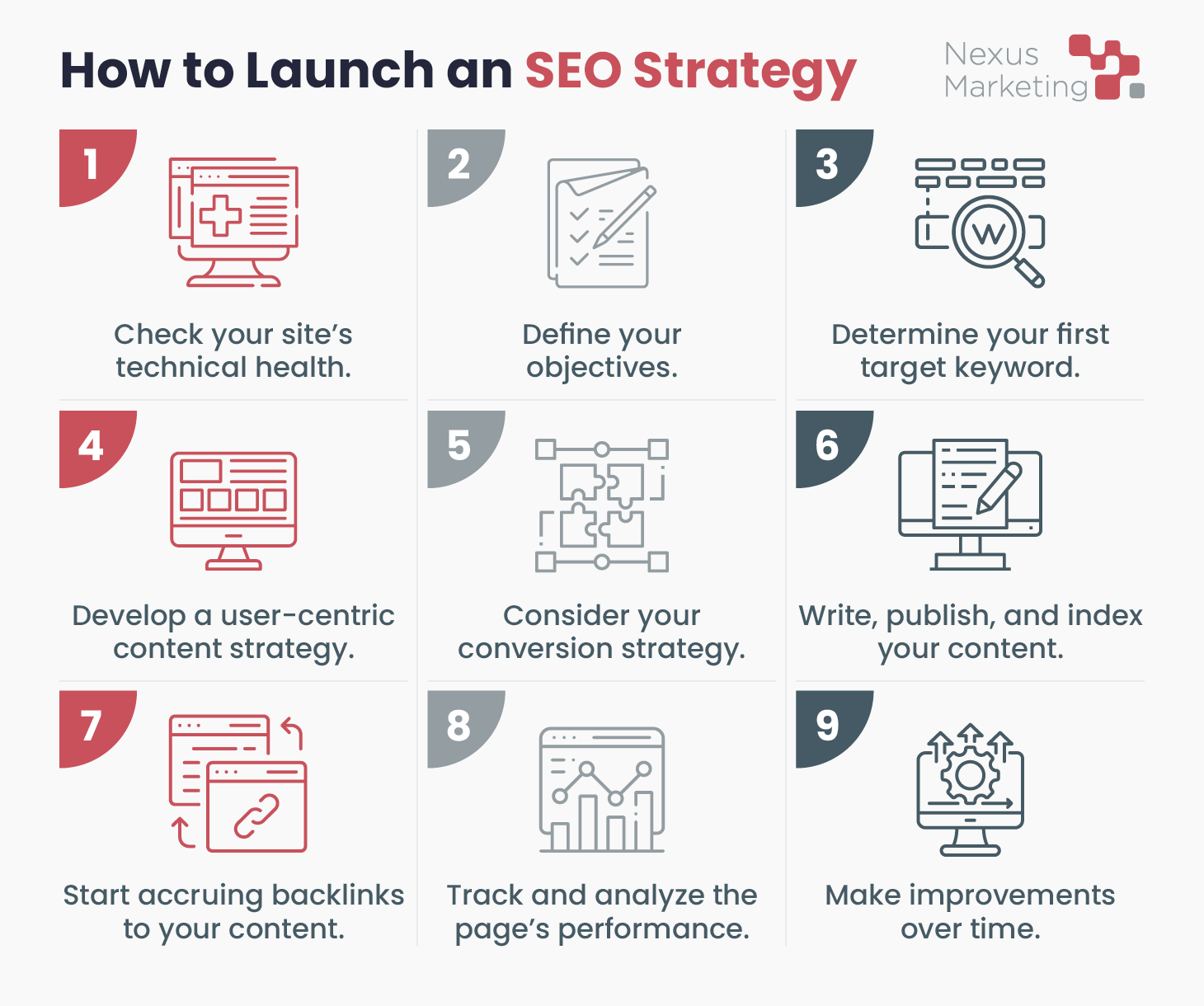
1. Check your site’s technical health.
Start with a quick website check-up:
For complete coverage and diagnostics, we recommend conducting a full technical SEO audit. Please contact us to learn more about this process and what it entails.
2. Define your objectives.
What are the core organizational objectives that you want to accomplish with SEO?
Remember, these should revolve around demand generation. Is there a particular offering or aspect of your nonprofit’s operations that you want to focus on first? These might include:
- Selling more of a specific product or service you offer
- Promoting a revenue-generating program
- Securing more registrants for a broadly appealing annual event
Under these objectives, you’ll set more tactical goals, like reaching Page 1 ranks for a certain number of your target keywords or increasing conversions on a specific landing page by X%.
3. Determine your nonprofit’s first target keyword.
Based on your most important objective, choose your first target keyword to pursue.
Ideal keywords for quick wins live in the “Goldilocks Zone” of high demand and low competition. This means it’s a topic searched by qualified leads without a ton of other high-authority websites crowding the SERPs with standout content. Writing a stellar article that educates this audience and introduces your offering can drive value relatively quickly.
SEO tools often have their own proprietary methods of gauging a keyword’s competitiveness. Moz’s Keyword Explorer is one of the easiest to use.
But you know your space (and your competitors and peer organizations), too—reviewing the existing SERPs of potential keywords can also give you a quick idea of who’s pursuing them and the caliber of content you’ll be up against.
Reminder: Don’t try going after a broad, high-traffic keyword yet. In many cases, these are the most competitive terms to rank for.
More specific keywords searched by users who are already lower in the sales funnel will give you the faster wins and momentum your strategy needs!
SEO agencies can help you lay out a more comprehensive keyword strategy and roadmap based on your objectives and the competitiveness of your space. This is one of the first steps that we take with new clients here at Nexus. Thorough upfront keyword research pays off!
4. Develop a user-centric content strategy.
Outline an article that will help you rank for your target keyword. You may already have an article that could rank if you update and improve it!
We recommend following these steps to sketch out a winning content strategy:
5. Consider your conversion strategy.
Before finishing your outline, take a moment to carefully think through how you’ll ask readers to convert—take a specific action that supports your organizational objective.
Depending on the context, this target conversion action might be:
- Purchasing your product
- Contacting you to learn more about a service
- Downloading a free digital resource
- Registering for your annual event
Think about your audience, their goals for searching the target keyword, and how your offerings align with that user intent. Pinpoint sections in your outline where you can promote your offering and ask users to take action.
These calls-to-action (CTAs) are often formatted as buttons, banners, and branded graphics that catch the eye. However you handle your CTAs, make sure they link straight to a landing page where users can take the target action. Common landing pages include contact or signup forms, lead capture pages to collect email addresses, and specific product/service pages.
6. Write, publish, and index your content.
Now comes the fun part!
Draft your article, give it a short and intuitive URL that includes the target keyword, review your draft, and make revisions. Bonus points for engaging visuals and videos—users and Google appreciate them! Make sure that your article is also attributed to an author, ideally a real person at your nonprofit. A more generic byline simply listing your organization can also suffice.
Hit publish, and then head over to Google Search Console. Search your new article’s URL and “request indexing.” This will fast-track the indexing and ranking process for your content
7. Start accruing backlinks to your nonprofit’s SEO content.
Once your content is live, you can begin the process of building backlinks to it.
Remember: Backlinks help show Google that your content is trustworthy, a key component of quality and ranking power.
Start with internal links. Identify several other pages on your nonprofit’s website where a link to your new content would make sense and enhance the user experience.
Next come external links to your content from other websites. This is a diverse practice all on its own. Authority-building by securing backlink placements with external partners is a core part of our process here at Nexus. The most common ways to secure backlinks include:
- Write short guest blog posts for other websites that include a link to your SEO content.
- Find mentions of your nonprofit on other websites using a quote search operator, then reach out to those websites to request a link to your content.
- Take the organic route by more generally building your brand’s visibility as it relates to that topic.
- For example, social media posts and links don’t directly contribute to SEO success, but they do spread the word about your content and can encourage other websites to build links organically.
Extra Context: Ethical Link-Building
Over the years, building backlinks has seen a lot of practices and trends come and go.
There is such a thing as unethical and improper link-building.
Spammy websites may use shady practices to build tons of links to their content in comments, forums, and garbled AI-generated content. Do not use these practices, and don’t hire any SEO vendors that use them.
If it detects that a site is violating its spam policies, Google can issue manual actions. These will directly penalize a website and prevent it from ranking well in the future. Not to mention, Google algorithm updates increasingly combat these practices and the rise of spammy AI content head-on. Trying to take a shortcut will result in headaches, not success.
Instead, accrue backlinks organically. Good content naturally secures links as it travels the internet. Reach out to your actual partners and peers to ask for links and blogging opportunities. These natural-looking links are much more valuable and worth your time.
Extra Context: The Importance of Brand-Building
Building brand recognition is increasingly important for SEO, although often in an indirect way.
In the age of AI, Google pays extra attention to names and brands that it understands to be recognized, connected, and respected in their topic areas. Cross-blogging with other websites is one way to build your nonprofit’s brand, but any positive publicity online can help.
At Nexus Marketing, our extensive partnership network has been a core part of our clients’ successes.
By building relationships with hundreds of high-quality, recognized brands in the mission-driven space, we can plug our clients right into the action.
Other activities like industry speaking engagements, influencer partnerships, and various digital PR opportunities all build your brand’s profile, as well. We’ve even built out an entire community, NXUnite, dedicated to fostering these connections between nonprofits, associations, businesses, and their audiences!
8. Track and analyze your page’s performance.
As you continue building links and your brand’s visibility, keep track of how your content is performing.
If you’ve invested in a dedicated SEO tool or professional SEO services, this is easy. You can access performance reports or receive them straight from your SEO agency—check out how we handle reporting with easy-to-use dashboards.
On your own, you can also use Google Search Console and Google Analytics to track your content’s visibility, traffic, and more. Just remember to dig deeper than topline numbers. Actual conversions—the number of users who take your target conversion action—are ultimately the most important metric for success.
This is why it’s essential to have a clear conversion strategy on your SEO pages. When you understand exactly what you’re asking readers to do and link your CTAs straight to the place to take action, you can easily measure clickthroughs to that landing page and the number of form completions.
9. Make improvements over time.
Finally, take the insights you’ve learned from keyword research, the content creation process, and your page’s performance metrics to make improvements over time.
It’s a good idea to regularly revisit your SEO content to audit its performance and compare it to fresher content on the SERP. We typically schedule these kinds of “refresh” activities for our clients because Google highly values fresh, actively maintained content. This is also when you can make improvements to your conversion strategy if needed.
Congrats! If you’ve followed along, you’ve just rolled out a preliminary SEO strategy for your nonprofit.
The beauty of this process is that it’s so easily repeatable. You just need the capacity to make research, content creation, and data analysis part of your ongoing marketing practices—which is why so many brands choose to partner with SEO agencies.
Hiring an SEO Agency for Your Nonprofit
Organizations of all shapes and sizes hire SEO agencies to handle the ongoing and day-to-day work of running an SEO strategy.
Successful strategies take dedicated time and effort, which is why they’re often postponed by busy organizations. Plus, SEO is a long-term strategy—it takes time to reap the full benefits—so faster marketing channels may receive attention first.
SEO agencies bring specialized experience and technical know-how that most nonprofits don’t have in-house.
Working with experts is the most effective way to get an SEO strategy off the ground, especially when they offer:
- Technical SEO audits
- Custom content creation
- Link-building services
- Networks of relevant partners in your industry
- Additional PR opportunities for your brand
These comprehensive services can support the whole lifecycle of your nonprofit’s SEO strategy, turning it from a time-consuming activity for your team to a revenue-generating channel that runs in the background. The right vendor will work with you to develop a custom strategy, maintain the health of your website, and let you be as hands-off (or hands-on) as you want.
So how do you hire one? We recommend these general steps:
Why Nexus Marketing Stands Out
Nexus Marketing is the leading SEO agency in the mission-driven space.
We’ve helped diverse organizations and businesses thrive online, reach the right audiences, and build powerful brands for a decade now. Check out our case studies!
What sets us apart? Deep expertise in mission-driven subject matter and extensive, organic connections in the space.
Plus, we offer a full range of additional content creation and PR opportunities to take your brand’s online visibility to the next level. Between custom email and video production, our influencer marketing program, and constant industry speaking opportunities, we’ve got you covered. These options allow you to drive both short- and long-term ROI, unique among SEO agencies.
Please contact us or learn more about our approach. Tell us about your nonprofit’s demand generation goals, and we’ll lay out a plan to reach them.

Learn More about SEO: Recommended Resources
Want to learn more about SEO for nonprofits? Check out our recommended resources:
Finally, don’t hesitate to reach out to us with any questions. Curious about anything covered in this guide? Have a unique SEO challenge in mind? We’re always happy to chat about SEO and the latest trends!


Cookieless Tracking, Google Analytics 4, and What It All Means for You
/in Deciphering SEO News/by David MyersThe ways that websites collect visitor data is changing fast. The biggest player in the space, Google, has been slowly implementing changes to catch up.
To stay compliant with evolving privacy regulations and to keep drawing reliable insights from your website’s performance (like the ROI of your SEO investments), you need to understand these changes. Specifically, you need to understand Consent Mode and its predictive modeling features in Google Analytics 4.
Here’s a quick guide to third-party cookie deprecation, “cookieless tracking,” and what they mean for your marketing analytics:
Quick disclaimer: We’re not tech or legal experts, we’re digital marketers.
This is our quick summary of changes in the digital privacy landscape and their implications on digital marketing. Please consult with a specialized professional if you have questions about your site’s compliance or backend consent management practices.
(But for questions about digital marketing, SEO, and tracking your lead generation results, we can definitely help.)
Update: July 2024
Since we originally published this guide, Google came out with a pretty huge announcement. The company has reversed course and will not phase out third-party cookies for users on its Chrome web browser.
Instead, Chrome will eventually ask users to choose privacy and cookie preferences that will apply across their entire browsing experiences. Search Engine Journal’s writeup provides a helpful summary.
What does this mean?
Google always keeps us on our toes!
For the full story, including context about privacy regulations, Consent Mode, and how to turn it on, please keep reading, and let us know if you have any questions!
Quick Context
Here’s the background:
Let’s say you understand the laws and your website actively asks for consent to use cookies. Everything seems to be running fine.
So what’s the issue?
There are two key areas where your brand could take a hit as a result of changing cookie practices: first-party data collection and advertising.
Impacts on First-Party Data Collection
Google Analytics uses first-party cookies to track engagement data of visitors on your website. These cookies are not considered “necessary” and thus require consent.
When users decline or ignore consent requests, this results in gaps in your data—potentially huge blank spaces in your digital marketing analytics.
You’ve likely already seen some of these effects as consent collection becomes the norm and as Google Analytics 4 has rolled out new compliance features and tools.
Without reliable data about how users are finding, engaging with, and leaving your website, your marketing strategy will suffer. Understanding user journeys and conversions is critical for improving over time, and this data is essential for measuring the ROI of your marketing strategies like SEO campaigns.
This is why this issue is top of mind for us here at Nexus Marketing. As the web evolves, we want our clients and partners to help lead the charge.
Impacts on Online Advertising
For brands that rely heavily on online advertising, particularly retargeting campaigns, the deprecation of third-party cookies on Google’s Chrome will be a major change.
As they currently work, these campaigns will be practically impossible without third-party cookies.
Many brands are still running late. An Adform survey found that:
Why It Matters
Cookie deprecation is already underway, and it’ll continue to be a major discussion in the coming months as Google moves ahead with its planned changes. You need a strategy for shifting your advertising and first-party data collection methods now.
Thankfully, Google appears to be on top of it. For advertising, Google has been developing new alternatives to third-party cookies. For data collection, GA4 has introduced new features that help fill data gaps.
We’ll take a closer look at GA4’s solution, behavioral modeling in Consent Mode, below—jump ahead to check it out.
And if you’ve already implemented Consent Mode, we’ll also discuss warning signs to look for that may indicate data isn’t flowing correctly.
Digital Privacy Regulations & Cookies
Here’s extra context that you may find helpful:
Why do cookies require consent?
Since the adoption of the GDPR and ePrivacy Directive in the EU, third-party cookies have been effectively banned for use on site visits from European visitors. Similar laws from the U.S. and around the world have since been enacted, too.
Even though not all of a site’s users will come from these jurisdictions, the laws are widespread enough today that it’s essentially easier to treat them as universal than it is to spend time and resources completely fine-tuning the site’s backend for different visitors.
This is why sites today expressly ask for user consent to use cookies. (Learn more about cookies here.)
Many of the big web players adapted fairly quickly. Web browsers like Safari and Firefox made fast changes to comply with the new norm. Apple has made frequent updates to the privacy features of iOS to stay in compliance, as well.
The effect has been that it’s now difficult for websites to track user behaviors on these browsers and systems for the purpose of retargeting them with ads.
Why has Google been slow to adapt?
Google implemented a solution in GA4 for mitigating the impacts of cookie consent, Consent Mode, back in 2020.
Since 2020, Google has also announced and postponed third-party cookie deprecation several times. The delays now appear to be coming to an end, with the current deadline sometime in 2025.
Why the delays? Google generates a lot of its revenue from advertising tools and services.
Third-party cookie deprecation directly limits their ability to operate, so Google has been working to develop alternative systems that will protect these revenue streams through its ambitious Privacy Sandbox initiative. With the 2025 phaseout period fast approaching, it seems like Google might finally be ready.
What’s the difference between first-party and third-party cookies?
Both types of cookies can serve a variety of purposes. For example, cookies are useful for remembering a user’s preferences. A first-party cookie will log this preference data in discrete events rather than as a longer flow of behaviors across multiple sites, as would a third-party cookie.
The biggest use case of third-party cookies by far is to glean insights from a user’s behavior across the web in order to target them with advertising and tailored content later.
Websites use Consent Management Platforms to ask for user consent, track consent collection, and implement the appropriate (or no) cookies as needed. This tool is essential for relaying users’ consent to Google Analytics.
Are third-party cookies illegal?
No, they’re not. But collecting user data without consent is illegal under the regulations discussed above.
In effect, then, most third-party cookies have been made useless (at least for websites that care about compliance).
Remember, too, that the regulatory landscape is constantly changing.
New, complex legislation spurs changes to the web browsers and systems that the whole world uses every day. These big changes filter down into the smaller tools that websites use to measure their traffic and engagement. As the landscape evolves, we can always expect to encounter broken code, malfunctioning website plugins, and more.
This is one of our key takeaways:
Stay aware and be intentional about what you install on your website and whether it’s working properly.
Here we should note that the term “cookieless tracking” is a bit of a misnomer.
Third-party cookies are being phased out on Google Chrome in 2025. Older methods of tracking web analytics relied on them heavily, so the scope of this change in recent years has been quite significant.
First-party cookies aren’t going anywhere. They’ll still be essential for understanding how users engage with your website, but the constantly changing privacy landscape and platform updates mean that they’ll be used in new and increasingly constrained ways.
In fact, these regulatory changes and the third-party cookie phase-out are what spurred the creation of the newest version of Google’s web analytics platform.
Privacy and Google Analytics 4
The shift from Universal Analytics (UA, the legacy version of the platform) to Google Analytics 4 (the newest version) is now complete. As of July 2024, all historical data stored in Universal Analytics properties is now unavailable.
GA4 is a robust platform. This upgrade from UA to GA4 introduced many up-to-date consent compliance features.
What’s the key difference between UA and GA4?
The core difference between these platforms is how their data models group incoming engagement data.
We won’t get too in the weeds, but the key takeaway is that GA4 allows for a much more granular and customizable understanding of how visitors are engaging with your website.
(If you’re curious, this article details the technical differences between the platforms in greater detail.)
Privacy features are integral to GA4.
The event-based structure of GA4 allows it to collect first-party data more seamlessly and in new ways that reduce privacy concerns.
It’s possible to collect user engagement data on GA4 without using third-party cookies or collecting IP addresses. This is done through first-party cookies. When users decline consent requests, these data gaps are filled using GA4’s Consent Mode.
What is Consent Mode?
Consent Mode is a feature that you can enable in your GA4 properties that ensures your tracking mechanisms properly adapt to user preferences. Google describes it as a tool that allows websites to collect data on website conversions while fully respecting users’ consent settings.
When Consent Mode is enabled, you’re then able to turn on a “behavioral modeling” feature that works to fill in the blanks in your analytics data through machine learning.
In a nutshell, here’s how it works:
This process is driven by machine learning. Although it’s still a relatively new technology and will keep evolving, it’s extremely helpful and gives us something much closer to the full data picture.
Learn more about Consent Mode with this list of FAQs.
Is Consent Mode mandatory?
Yes. As of March 2024, Consent Mode is now mandatory for all websites that use Google Analytics and/or Google Ads.
Without Consent Mode, you risk noncompliance with key European and other regulations. Not enabling Consent Mode will also make collecting data for users in many jurisdictions around the world and/or who reject cookie consent essentially impossible. The data that you would collect would be incomplete and give you a warped view of events, engagement, and conversions on your website.
But by enabling Consent Mode, you’ll stay compliant and be able to use helpful GA4 features that fill in gaps in your analytics.
How to Implement Consent Mode and Behavioral Modeling
Let’s dive into the details about exactly how to ensure these features are enabled in your GA4 properties. First, some important clarification:
We’ll take a look at each of these elements below.
Enabling Consent Mode
There are two ways Consent Mode can be enabled on your website depending on how you currently manage user consent preferences.
If you take the manual route, here’s what you’ll need to know:
First, you need to establish a default consent state for when users first arrive on your website. The default should be consent denial. Within your site’s code, add a script that establishes these defaults before the main Google Tag Manager script begins.
Next, update your hard-coded cookie consent banner to communicate user choices (and effectively override the default settings) by adding a new script:
From here, navigate to your Google Tag Manager. You’ll need to enable “Consent Overview” to ensure that GA4 picks up on the changes you’ve made manually and so that you can further customize the consent settings for tags if needed.
Here’s Google’s technical guide to implementing these coded changes. This video overview also explains the steps in greater detail if you’re curious:
Remember: In most cases, websites already use Google-certified Consent Management Platforms and will not need to handle these steps manually. Double-check what tool your website uses if you’re unsure.
If you do already use a CMP, explore its settings or reach out to its support team to confirm that Consent Mode has been activated for your properties.
Understanding Conversion Modeling
When Consent Mode is activated and running smoothly, your GA4 instance should be able to automatically model conversion data to help fill in data gaps.
Why is this necessary?
If a user declines consent but ultimately converts on your website (defined in GA4 as triggering a “Key Event”), their initial source will be reported only as “Direct.” They’ll be added to a bucket of unattributed conversions. This isn’t terribly helpful for understanding your website’s marketing performance.
Conversion modeling brings back attribution by mixing machine learning and observable data (either consented or highly limited, anonymized session start data). This diagram explains the value of Conversion Modeling:
In this example, 20 users out of 100 converted. Without conversion modeling, the 10 of those users who declined consent are reported in GA4 as coming from a Direct source. Conversion modeling uses a mix of data to resort those users’ sources more accurately.
For marketers, conversion modeling is arguably the most important of GA4’s new AI- and privacy-related features to understand.
Conversion modeling should also occur in your GA4 properties automatically once Consent Mode is enabled. You don’t need to manually enable it.
However, know that you’ll gain the most useful insights from this feature if your website if your website generates enough conversions to provide Google with enough data to make predictions:
Here’s a helpful guide to conversion modeling if you want to learn more.
Behavioral Modeling in Consent Mode
For many websites, GA4 offers an additional feature that fills in gaps in your analytics: behavioral modeling.
This feature pulls from observable data and predictive, AI-driven insights to help you estimate the exact events and interactions that occur across your website.
It’s important to note first that not all websites can use behavioral modeling through Consent Mode. Google lays out these eligibility requirements:
Why does Google set these requirements? For the behavioral modeling system to work correctly, it needs enough data to learn from. Without enough input data from both consented and unconsented users, the system is unable to make meaningful predictions.
If your website meets these requirements, great! We’ll explain below how to ensure behavioral modeling is enabled in your GA4 properties.
If your website does not meet these requirements, don’t worry. Of everything discussed in this guide, Consent Mode and conversion modeling are the most important for 1) ensuring compliance and 2) learning about your big-picture marketing performance. Behavioral modeling provides a more granular look at specific interactions on your website, but unless you have highly robust digital marketing practices, you likely won’t be missing much or any data that you would have previously used.
Remember that conversions are what create ROI for your marketing efforts, not smaller events.
Enabling Behavioral Modeling
Here’s a quick explanation of the implementation process for behavioral modeling:
Items to note in this explainer:
That’s it—turning on behavioral modeling is a simple process with only one manual step for most websites. Here’s where to turn on the correct reporting option for that last step:
Setting your property’s reporting identity to “blended” tells Google to activate the behavioral modeling system and begin incorporated predicted data into your analytics reports.
Want a closer look at how GA4’s modeling systems work and how to enable behavioral modeling? Here’s an overview from Google:
Next Steps
For Nexus Marketing clients, contact your Account Manager if you have any questions about this guide, your GA4 properties, and whether Consent Mode is activated for them. We can help you check and determine the appropriate next steps.
If You’ve Already Implemented Consent Mode
We mentioned above that broken functionalities are to be expected in the coming months and years. Some websites are already seeing issues with traffic attribution as Google fine-tunes its approach to privacy regulation adherence.
Depending on the mix of tools installed on your site and your GA4 settings, your data reporting not be working properly.
How can you tell? Here are a few signs that something isn’t working:
Now may be the right time to quickly double-check your GA4 properties to look for any strange patterns or traffic drops.
Once they’re identified, the process of troubleshooting and correcting them shouldn’t be too difficult.
This is a rich (and complicated) topic that won’t be going away anytime soon, so we encourage you to keep learning about third-party cookie deprecation, cookieless tracking, and GA4. Here are a few resources that we’ve found helpful:
Deciphering SEO News: The Infamous 2024 Google Leak
/in Deciphering SEO News/by David MyersThe dust has settled after another big news story in the SEO world: a purported leak of internal Google data about how its ranking algorithm works.
If you’re plugged into the SEO sphere, you likely caught wind of the drama. But if it’s news to you, you’re not alone. Either way, you likely have some questions.
Now that we have more context about the leak, the Nexus Marketing team wanted to offer a quick overview and our take on its implications for your organization’s SEO.
What happened?
On May 5th, 2024, SEO thought leader Rand Fishkin received news of leaked Google API documentation from a source claiming that it came from Google’s secretive Search Division. On May 27th, Fishkin published a full write-up:
It immediately became the biggest topic in the SEO world in years—the buzz eclipsed even the very recent rollout of AI Overviews.
Since then, the leaked information has been a major point of controversy. We’ll dig into why it’s controversial among SEO professionals, but first, let’s clarify:
Was this a leak of the actual Google ranking algorithm?
No. At this point, it’s been pretty much disproven.
Here’s how SEO expert, Eli Schwartz, put it in a recent newsletter:
What information did the Google leak include?
So, what exactly did the leaked Google API documentation include?
It includes detailed lists of over 14,000 named protocols that Google’s Document AI Warehouse potentially uses to understand and sort information.
Some of the specific protocols that caught people’s attention include:
siteFocusScore
A potential representation of a site’s topical authority, or how closely it sticks to its relevant subject matter
siteRadius
A potential measure of how closely a given page aligns with the site’s core topics
EffortScore
A potential estimate of the relative effort that went into content creation on a page, related to Google’s PageQuality measures
freshdocs
A “link value multiplier” that appears to weigh the value of links from newer pages over links built on older pages
fullLeftContext and fullRightContext
Protocols that appear to tell Google to interpret the surrounding context of a link’s anchor text, meaning anchor text like “click here” can still be understood
Mentions of the NavBoost system
A system of protocols that likely reranks results based on their click metrics (as an approximation of content quality, user satisfaction, etc.)
Based on this information, many SEO professionals quickly assumed that these or similar factors are used in the Google Search algorithms to understand and rank content out in the wild. The thinking is that if Google has supposedly built these systems and features, they’re likely deployed elsewhere.
Note how often we use “potential” in these descriptions—remember that we don’t know for sure whether these factors are actually included in Google Search algorithms.
Want to go deeper? This SearchEngineLand article explains more of the specific protocols included in the leak. However, keep in mind that this article was published before we learned more about the actual provenance of the data—take its analyses of the leak’s SEO implications with a grain of salt.
Want an even deeper dive? (Not highly recommended, but it’s definitely interesting!) Here’s a comprehensive table of all the protocols found in the leaked documentation:
How did the SEO world react and why?
The news of the Google leak created waves immediately. First reactions ran the gamut from measured skepticism to frenzied anger to jaded dismissal.
Now that a few weeks have passed and we’ve learned more about the leaks, the buzz has calmed significantly.
First, some context. Whenever we get news of big Google shake-ups, algorithm changes, and hints about how the ranking algorithm works, a similar swarm of reactions occurs.
The SEO space is as diverse as the internet itself. When websites use released information to make assumptions about updated SEO best practices, not all of them will reap benefits. Some may actually see decreased SEO performance. No two sites will experience an algorithm update the same way or see the same impacts from making similar changes to their content.
This, understandably, can create frustration and blame-casting.
Some SEO professionals then assume that Google intentionally misleads them. Seemingly contradictory statements or mixed results from implementing assumption-based changes fuel the fire.
Many immediately thought the leaked information came directly from the core Search ranking algorithms. Many of the signals and features included in the leak do seem to contradict past statements from Google about how Search works. Confirmation bias set in, and we saw some angry and jaded reactions.
But fast forward just a few days.
A clearer picture of the leak emerged. Here’s how Search Engine Journal article put it in late May, 2024:
“Many SEOs [have come] to the conclusion that the alleged Google data leak was not a leak, did not contain ranking algorithm secrets, was five years out of date, and did not show anything new. While that’s not how everyone feels about it, SEOs in general don’t tend to agree about anything.”
The leak is complicated. And while some in the space distrust Google’s statements, jumping to black-and-white conclusions one way or the other is never the best move.
Why Does it Matter?
All this context might be confusing. We get it, so why are we sharing it?
We want to arm our clients and partners (and everyone else) with knowledge and a healthy dose of skepticism.
If you work in marketing and encounter SEO news and trends, you need to understand why we see a range of dramatic reactions to industry developments as they break. These reactions tend to die down after a few days, and then the real takeaways emerge after that (and we’ll tell you about them).
Extra Context: Why is the algorithm a secret, anyway?
To be fair, Google does very carefully word its releases and public discussions of algorithm details. Why?
If Google were to fully publicize its algorithmic ranking factors or even discuss a single new one in great depth, it could wreak havoc on the search results. Here’s a hypothetical:
A little dramatic, maybe, but that’s the general idea why Google is so secretive about the exact makeup of its ranking algorithms.
What does it mean for your website?
Honestly, not much.
If you follow tried-and-true best practices, create quality content for your users, build links to it, and maintain your website’s health, you’re already ahead!
But even if the leaked information did come directly from the Search algorithm, it wouldn’t have taught us much that we didn’t already know or couldn’t piece together.
If you pay attention to Google’s big-picture changes (like their Helpful Content Update, spam crackdown, and the rollout of AI Overviews), you can already infer that more deeply understanding the context and quality of content has been a big priority. It makes sense that Google would want to be capable of piecing together the full context of the language surrounding a link, for instance.
But if you’re already creating excellent, user-centric, well-organized content, this shouldn’t even be a concern.
Here’s our take:
When SEO professionals take leaks, rumors, clickbait strategies, and Google’s hints too literally, it’s no surprise when they see mixed results.
Google’s ranking system is extremely complex, with thousands and thousands of ranking factors constantly in flux.
It’s not a checklist or recipe of exact measurements to get just right. And you definitely don’t succeed at SEO by taking dramatic swings at big strategy changes based on assumptions and expecting all-or-nothing results.
SEO success comes from building up your website’s quality, helping your users, and creating a respected brand. You’ll satisfy algorithm signals along the way, and Google will learn to recognize you for your hard work.
To sum it all up, we love this quote from SEO thought leader, Eli Schwartz:
“The user pays your bills, not the search engines.”
Learn from a balanced mix of sources—Google’s statements, firsthand trial and error, experts in the field, and your audiences’ needs.
This is exactly how we approach SEO at Nexus Marketing, and it’s served our clients well for a decade now. Want to learn more? We’d love to hear from you.
Have any questions or want to learn more about our approach to SEO?
Contact us or reach out directly to your Nexus points of contact at any time!
SEO for Nonprofits: Quick Start Guide
/in Client & Industry Resources/by David MyersA user does a quick Google search for a program or service that your nonprofit provides.
What if your nonprofit was the very first thing they see?
Search engine optimization (SEO) isn’t just for big for-profit brands—any organization that depends on reaching online audiences to promote its programs, services, and products can benefit from an SEO strategy.
Yes, that includes nonprofit organizations! In 2023, NP Tech for Good found that just 37% of nonprofits have dedicated SEO strategies. Considering the long-term value that effective SEO generates, this is a huge missed opportunity for the sector and communities around the world.
SEO is completely learnable and built on straightforward technical and marketing concepts. We’ll cover them all here:
Ready to grow your nonprofit’s services and product revenue?
What is SEO?
Search engine optimization (SEO) is the process of technically maintaining your website and publishing high-quality, keyword-optimized content to help a website appear higher in organic search engine results.
Within the broader field of SEO, you’ll encounter some more specific practices:
Quick context: Organic search results are any that are not paid ads (like the Google Ads you’re likely used to seeing). Search engine results pages are often called SERPs, which we’ll use in the rest of this guide.
What are the Goals of SEO?
Organizations of all types and sizes use SEO strategies to rank higher for their target keywords. By ranking higher, they can:
Spoiler Alert: Effective, ongoing SEO has a powerful flywheel effect.
In other words, when your website is a trusted source of high-quality content, it’s more likely to rank higher for a wider range of keywords, further growing your visibility (and incoming customers).
Why SEO Matters for Nonprofits
SEO is a smart investment for many nonprofit organizations for several reasons. These include:
Digital Advertising vs. SEO for Nonprofits?
Organic search SEO is often weighed against paid search ads, with many nonprofits opting to increase their ad spend rather than launch an SEO strategy.
Is there one right option? No, the nonprofit sector and organizations’ revenue streams are too diverse to generalize about optimal strategies.
However, for some types of nonprofits, SEO is a major missed opportunity. It’s an ideal way to build awareness and demand for programs, services, and products that generate revenue. It’s not a great long-term choice for generating fundraising dollars.
We’ve gathered a few salient points from the most recent M+R Benchmarks Report (our favorite source for up-to-date insights on the state of nonprofit digital marketing):
The story is different for every nonprofit and mix of revenue streams. But looking at those last numbers, it’s clear that for many organizations there are much more cost-effective channels (like SEO) for generating leads. Looking at you, social media ads.
Here’s how the report summed it up:
Essential Points to Remember
There are a few big-picture points to keep in mind to succeed with SEO for your nonprofit. Here are the essential reminders that we often discuss with our SEO clients:
Simply put, demand generation should be the overarching goal of SEO, not leading metrics like web traffic.
A Closer Look at SEO Goals for Nonprofits
For nonprofit organizations specifically, SEO is better for marketing some types of your offerings than others:
When you focus your SEO strategy on scalable, sales-based revenue sources, you create a much clearer path to success. Think of it like this:
While SEO can help build awareness of your mission and brand, perhaps eventually leading to donations if you capture users’ attention and contact information, the timeline of this ROI is extremely long. You’re much more likely to receive a donation from someone with a pre-existing relationship with your nonprofit.
But if you offer specific programs, services, and products that generate revenue for your mission, SEO is the key to reaching your target audiences efficiently.
We advise our clients that short-term or fundraising-based goals are better supported with other marketing channels like direct email outreach, paid ads, social media, or specialized local SEO services. In other words, SEO should be an ongoing, foundational marketing activity on which you layer additional channels and campaigns to support specific objectives.
How SEO Works
With the context squared away, let’s get into the nitty-gritty—how does SEO work? How does a page go from unranked to dominating the SERP?
Here’s a condensed rundown of the basics of SEO:
1. Search engines like Google use crawler bots to explore the internet. They screen content, pick up on keywords and concepts, check out the links it includes, and log all of its contextual information as part of its algorithmic ranking system.
This process is called indexing. If a page cannot be indexed, it won’t appear in Google results and is likely the result of a technical issue with your website.
2. Google pays extra attention to links. When one website links to another, Google considers this a kind of vote of confidence, a little stamp of approval that says, “I trust this source enough to show it to my audience.” Over time, pages accrue backlink profiles of all the other pages on the internet that link to them.
3. Pages are analyzed and ranked for EEAT. EEAT stands for Experience, Expertise, Authoritativeness, and Trustworthiness. It’s a helpful shorthand for understanding how Google defines truly “helpful,” rankable content:
There’s some overlap between these concepts, but taken as a whole, they give us a reliable picture of the content Google wants to serve its users.
Extra Context: The Google Algorithm
A combination of algorithmic and human scoring—from real content reviewers—is used to gauge how highly a web page should rank and for which keywords.
Google also uses AI-based natural language processing systems to interpret content and map interrelated concepts, which has allowed it to better understand content quality over time.
Google’s ranking algorithm is notoriously complex and constantly changing, with hundreds of different ranking factors being tweaked, prioritized, and deprioritized over time. Historically, Google has been secretive about the exact makeup of the algorithm, but a recent leak (huge news in the SEO world!) gave us more direct insight into its current ranking factors than ever before.
4. When users search keywords or longer phrases, Google delivers a mix of content. Google makes assumptions about the user’s intent from the keyword—what they’re trying to accomplish with their search—which informs the mix of SERP features that it delivers.
These always include organic results, pages that have organically demonstrated their EEAT to Google. Most SERPs also include pay-per-click (PPC) ads, which are indicated with “Sponsored” taglines.
SERPs usually also include features designed to quickly provide answers and satisfy that particular user intent.
Extra Context: Types of SERP Features
The biggest new SERP features to be aware of are AI Overviews (more on these below), but other common features include:
Google scrapes relevant content to populate these SERP features. This is usually an indication of high quality. If your page gets highlighted in a Featured Snippet, you’ll secure even more valuable SERP real estate!
5. User engagement signals impact the ranks over time. Based on how users engage with the results on SERPs, Google’s ranking algorithm refines its inferences and makes adjustments over time.
Extra Context: User Engagement Signals
When Google users interact (or don’t interact) with results on SERPs, it generates a measurable user engagement signal. The most important examples include:
These metrics indirectly measure how well your content satisfies users’ queries and the search intent for that particular keyword.
Although Google has long denied that engagement metrics play central roles in the SEO ranking process, that story is changing. Many SEO experts predict that Google’s increased ability to understand content, engagement metrics, and their correlations will make engagement metrics more prominent parts of the ranking algorithm over time. The takeaway? User experience and content quality are prerequisites for success!
SERPs never stand still for long. In addition to user engagement signals, rankings can change for all kinds of reasons:
It’s important to keep track of your SEO performance and identify slippages so that you can make targeted content improvements—we’ll explain this process in the playbook below.
6. Google comes to recognize some domains as more authoritative than others. As a website publishes more high-quality SEO-optimized content and accrues backlinks, Google will recognize that domain as a reliable source of helpful content about its core topics. It then gets prioritized in more SERPs—a powerful flywheel effect that amplifies your SEO success.
To measure a domain’s authoritativeness, SEO professionals use a variety of proprietary metrics. At Nexus Marketing, we’ve long relied on Moz’s Domain Authority score as a rough gauge for how well-established a website is in the eyes of Google.
Key Elements of SEO-Optimized Content
Ok, so you understand how Google ranks content. In tactical terms, what are the specific elements that your organization’s content needs to catch Google’s attention? Good question.
The Nexus team spends all day thinking about, researching, and writing SEO-optimized content for our clients and partners. Here are our top recommendations and the specific elements we always include in SEO articles.
Our Top Advice for Creating SEO Content
Our three most important rules of thumb for creating effective SEO content:
From these tips, you can probably tell that there is no one-size-fits-all SEO content template you can follow for SEO success. Stuffing keywords into a generic article and hitting publish may have worked once upon a time, but those days are long gone.
Users and Google alike want quality content from trustworthy sources. The length, structure, and complexity of your content should be tailored to the audience’s needs. If the keyword calls for a long, educational guide, that’s what you should create. If the keyword calls for very short definitions and quick bits of information about a product or service, create that content.
Elements to Optimize in SEO-Optimized Content
Even though there’s no single template for SEO content, there are specific technical elements that any web content intended to rank should include. The most important of these are:
SEO for Nonprofits in the AI Age
The rise of generative AI has been a seismic shift for the marketing world, and especially for SEO. The introduction of AI Overviews directly in SERPs has probably shaken up the industry more than any other update in decades.
However, anytime you search “AI in [insert industry here]” to learn more, you’re likely to see a slew of dramatic editorials and conflicting claims. It’s the same in the SEO space, and it’s more confusing than helpful for newcomers.
We’ve already written a few guides that spell out our positions on the implications of AI on SEO:
Misusing or misunderstanding AI can create all kinds of risks for your nonprofit’s website. If you don’t have time to read these articles, we hope you take away these key points:
Your Nonprofit’s First SEO Playbook
Ready to get started? Here are the core steps for launching an SEO strategy for your nonprofit for the first time.
1. Check your site’s technical health.
Start with a quick website check-up:
For complete coverage and diagnostics, we recommend conducting a full technical SEO audit. Please contact us to learn more about this process and what it entails.
2. Define your objectives.
What are the core organizational objectives that you want to accomplish with SEO?
Remember, these should revolve around demand generation. Is there a particular offering or aspect of your nonprofit’s operations that you want to focus on first? These might include:
Under these objectives, you’ll set more tactical goals, like reaching Page 1 ranks for a certain number of your target keywords or increasing conversions on a specific landing page by X%.
3. Determine your nonprofit’s first target keyword.
Based on your most important objective, choose your first target keyword to pursue.
Ideal keywords for quick wins live in the “Goldilocks Zone” of high demand and low competition. This means it’s a topic searched by qualified leads without a ton of other high-authority websites crowding the SERPs with standout content. Writing a stellar article that educates this audience and introduces your offering can drive value relatively quickly.
SEO tools often have their own proprietary methods of gauging a keyword’s competitiveness. Moz’s Keyword Explorer is one of the easiest to use.
But you know your space (and your competitors and peer organizations), too—reviewing the existing SERPs of potential keywords can also give you a quick idea of who’s pursuing them and the caliber of content you’ll be up against.
SEO agencies can help you lay out a more comprehensive keyword strategy and roadmap based on your objectives and the competitiveness of your space. This is one of the first steps that we take with new clients here at Nexus. Thorough upfront keyword research pays off!
4. Develop a user-centric content strategy.
Outline an article that will help you rank for your target keyword. You may already have an article that could rank if you update and improve it!
We recommend following these steps to sketch out a winning content strategy:
1. Check the competition.
Review the SERP for the target keyword and read the content that’s already ranking. What does it include? What does it do well? How could your content go further?
2. Consider your audience’s intent.
Consider what the audience really wants when they search this keyword—quick answers, a thorough guide, or a product or service page?
3. Analyze the SERP.
Take a look at the additional topics and snippets that the SERP includes, and consider how you can include these topics to catch Google’s attention.
4. Draft a title.
Write an enticing title that includes the target keyword and is between 50 and 60 characters long.
5. Outline your headings.
Outline the core topics and subtopics that the article will cover using a logical order of H2 and H3 headings. Make sure to include the keyword and natural variants throughout the headings.
6. Flesh out the outline.
Expand your outline with the same level of (or ideally, more) detail and background that other ranking content includes.
7. Go a step further.
Identify spots to inject your nonprofit’s unique take using relevant data and donor and constituent stories.
5. Consider your conversion strategy.
Before finishing your outline, take a moment to carefully think through how you’ll ask readers to convert—take a specific action that supports your organizational objective.
Depending on the context, this target conversion action might be:
Think about your audience, their goals for searching the target keyword, and how your offerings align with that user intent. Pinpoint sections in your outline where you can promote your offering and ask users to take action.
These calls-to-action (CTAs) are often formatted as buttons, banners, and branded graphics that catch the eye. However you handle your CTAs, make sure they link straight to a landing page where users can take the target action. Common landing pages include contact or signup forms, lead capture pages to collect email addresses, and specific product/service pages.
6. Write, publish, and index your content.
Now comes the fun part!
Draft your article, give it a short and intuitive URL that includes the target keyword, review your draft, and make revisions. Bonus points for engaging visuals and videos—users and Google appreciate them! Make sure that your article is also attributed to an author, ideally a real person at your nonprofit. A more generic byline simply listing your organization can also suffice.
Hit publish, and then head over to Google Search Console. Search your new article’s URL and “request indexing.” This will fast-track the indexing and ranking process for your content
7. Start accruing backlinks to your nonprofit’s SEO content.
Once your content is live, you can begin the process of building backlinks to it.
Start with internal links. Identify several other pages on your nonprofit’s website where a link to your new content would make sense and enhance the user experience.
Next come external links to your content from other websites. This is a diverse practice all on its own. Authority-building by securing backlink placements with external partners is a core part of our process here at Nexus. The most common ways to secure backlinks include:
Extra Context: Ethical Link-Building
Over the years, building backlinks has seen a lot of practices and trends come and go.
There is such a thing as unethical and improper link-building.
Spammy websites may use shady practices to build tons of links to their content in comments, forums, and garbled AI-generated content. Do not use these practices, and don’t hire any SEO vendors that use them.
If it detects that a site is violating its spam policies, Google can issue manual actions. These will directly penalize a website and prevent it from ranking well in the future. Not to mention, Google algorithm updates increasingly combat these practices and the rise of spammy AI content head-on. Trying to take a shortcut will result in headaches, not success.
Instead, accrue backlinks organically. Good content naturally secures links as it travels the internet. Reach out to your actual partners and peers to ask for links and blogging opportunities. These natural-looking links are much more valuable and worth your time.
Extra Context: The Importance of Brand-Building
Building brand recognition is increasingly important for SEO, although often in an indirect way.
In the age of AI, Google pays extra attention to names and brands that it understands to be recognized, connected, and respected in their topic areas. Cross-blogging with other websites is one way to build your nonprofit’s brand, but any positive publicity online can help.
At Nexus Marketing, our extensive partnership network has been a core part of our clients’ successes.
By building relationships with hundreds of high-quality, recognized brands in the mission-driven space, we can plug our clients right into the action.
Other activities like industry speaking engagements, influencer partnerships, and various digital PR opportunities all build your brand’s profile, as well. We’ve even built out an entire community, NXUnite, dedicated to fostering these connections between nonprofits, associations, businesses, and their audiences!
8. Track and analyze your page’s performance.
As you continue building links and your brand’s visibility, keep track of how your content is performing.
If you’ve invested in a dedicated SEO tool or professional SEO services, this is easy. You can access performance reports or receive them straight from your SEO agency—check out how we handle reporting with easy-to-use dashboards.
On your own, you can also use Google Search Console and Google Analytics to track your content’s visibility, traffic, and more. Just remember to dig deeper than topline numbers. Actual conversions—the number of users who take your target conversion action—are ultimately the most important metric for success.
This is why it’s essential to have a clear conversion strategy on your SEO pages. When you understand exactly what you’re asking readers to do and link your CTAs straight to the place to take action, you can easily measure clickthroughs to that landing page and the number of form completions.
9. Make improvements over time.
Finally, take the insights you’ve learned from keyword research, the content creation process, and your page’s performance metrics to make improvements over time.
It’s a good idea to regularly revisit your SEO content to audit its performance and compare it to fresher content on the SERP. We typically schedule these kinds of “refresh” activities for our clients because Google highly values fresh, actively maintained content. This is also when you can make improvements to your conversion strategy if needed.
Hiring an SEO Agency for Your Nonprofit
Organizations of all shapes and sizes hire SEO agencies to handle the ongoing and day-to-day work of running an SEO strategy.
Successful strategies take dedicated time and effort, which is why they’re often postponed by busy organizations. Plus, SEO is a long-term strategy—it takes time to reap the full benefits—so faster marketing channels may receive attention first.
SEO agencies bring specialized experience and technical know-how that most nonprofits don’t have in-house.
Working with experts is the most effective way to get an SEO strategy off the ground, especially when they offer:
These comprehensive services can support the whole lifecycle of your nonprofit’s SEO strategy, turning it from a time-consuming activity for your team to a revenue-generating channel that runs in the background. The right vendor will work with you to develop a custom strategy, maintain the health of your website, and let you be as hands-off (or hands-on) as you want.
So how do you hire one? We recommend these general steps:
1. Learn more about SEO services.
As you can tell from this guide, the world of SEO services and practices is diverse.
Different agencies offer a wide variety of services, ranging from full custom SEO engagements and content creation to periodic technical check-ins. Consider the scale of support you want.
Also, consider your timeframe—ongoing strategy execution (recommended for long-term SEO success) or one-time projects (which can work if you have very specific needs). Keep in mind that SEO takes time to bear fruit. Overnight results are not likely.
Learn more about our SEO client engagements to get a sense of the range of services and options available.
2. Define your needs and objectives.
Do you have specific organizational objectives that you want to accomplish with SEO?
Or do you simply know that it’s a neglected channel in your nonprofit’s marketing strategy?
Either answer is fine! It’s useful to understand your reasons for investing in SEO before getting in touch with vendors. This will ensure you both come to the table with clear expectations about your needs and the best potential solutions.
3. Set a monthly budget.
Most SEO agency services are paid monthly, similar to other marketing and advertising services.
Although you may ultimately budget a total annual or quarterly spend depending on the terms of your contract with an agency, they typically charge an hourly rate for their services. You’ll purchase a set number of hours for your engagement to be delivered each month, with your total cost based on the hourly rate and projected over the course of the engagement.
This means your monthly budget for SEO will be the most helpful financial number to bring into the research and vetting process.
4. Research specialized vendors.
Now it’s time to start researching potential SEO vendors.
Google searches, chats with peers in other organizations, and calls for recommendations on LinkedIn are all reliable starting points.
The nonprofit space is distinct from the for-profit B2C and B2B worlds. Your audience has different needs and interests than generalist services will likely be able to satisfy. Link- and brand-building, essential for sustained SEO success, will also be challenging for generalist agencies.
Look for agencies that have:
(Quick note: We check all these boxes, and we’d love to chat!)
5. Dig deeper into your candidates.
When you have a shortlist of candidates, look at their track records. Check out things like:
6. Chat with your top vendors.
Now, reach out to your top options by requesting information about their services or how they’d support your organization.
At this point, agencies will likely walk you through their approach to SEO and case studies of their past successes with clients. This is also the time to ask questions.
Note that the full process of learning more, looping in the relevant stakeholders, and securing buy-in may take a while and require multiple meetings. The right agency will be happy to adapt and make sure you’re getting all the information you need!
7. Discuss terms.
Once you’ve chosen an SEO agency, ask for a more formal outline of the proposed engagement, its terms, and the cost.
The process of discussing the contract’s terms and making adjustments may take some time, but keep in mind that SEO is a long-term marketing investment—it’s always worth ensuring you’re happy with your new partnership!
8. Prepare for onboarding!
Congrats! Your SEO strategy is about to take flight. But first, your SEO agency will likely have some onboarding steps and requests for you to take care of.
These typically include providing marketing and branding assets, answering more in-depth questionnaires about your lead generation activities and goals, and granting backend access to your website.
Why Nexus Marketing Stands Out
Nexus Marketing is the leading SEO agency in the mission-driven space.
We’ve helped diverse organizations and businesses thrive online, reach the right audiences, and build powerful brands for a decade now. Check out our case studies!
What sets us apart? Deep expertise in mission-driven subject matter and extensive, organic connections in the space.
Plus, we offer a full range of additional content creation and PR opportunities to take your brand’s online visibility to the next level. Between custom email and video production, our influencer marketing program, and constant industry speaking opportunities, we’ve got you covered. These options allow you to drive both short- and long-term ROI, unique among SEO agencies.
Please contact us or learn more about our approach. Tell us about your nonprofit’s demand generation goals, and we’ll lay out a plan to reach them.
Learn More about SEO: Recommended Resources
Want to learn more about SEO for nonprofits? Check out our recommended resources:
Finally, don’t hesitate to reach out to us with any questions. Curious about anything covered in this guide? Have a unique SEO challenge in mind? We’re always happy to chat about SEO and the latest trends!
SEO for Associations: Free Strategy Playbook
/in Client & Industry Resources/by David MyersA user does a quick Google search for a training service or professional certification they need.
What if your association was the very first thing they see?
Search engine optimization (SEO) isn’t just for big for-profit brands—any organization that promotes its programs, services, and products to online audiences can benefit from an SEO strategy. Yes, that includes associations!
There’s a common misconception that SEO involves some kind of wizardry to achieve top rankings on search engines. Far from it.
SEO is built on straightforward technical and marketing concepts. Master them, put them into action, and you’ll build a solid SEO foundation for your association in no time. We’ll cover them all here:
Ready to grow your association’s services and product revenue?
What is SEO?
First, the basics. Search engine optimization (SEO) is the process of technically maintaining your website and publishing high-quality content to appear higher in organic search engine results.
Within the broader field of SEO, you’ll encounter related sub-fields of more specific practices. These include:
Quick context: Organic search results are any that are not paid ads (like the Google Ads that you’re likely used to seeing). Search engine results pages are often referred to as SERPs, which we’ll use in the rest of this guide.
What are the Goals of SEO?
Organizations of all types and sizes use SEO strategies to rank higher for their target keywords. By ranking higher, they can:
Spoiler Alert: Effective, ongoing SEO has a powerful flywheel effect.
In other words, when your website is trusted as a source of high-quality content, it’s more likely to rank higher for a wider range of keywords, further growing your visibility (and incoming sales leads).
Why SEO Matters for Associations
SEO is a smart investment for associations for several reasons:
Essential Points to Remember
To succeed long-term with SEO, you need to keep a few North Stars in mind. Here are the essential reminders that we often discuss with our SEO clients:
Simply put, demand generation should be your goal, not leading metrics like web traffic.
A Closer Look at SEO Goals for Associations
Keep in mind that SEO is better for marketing some types of your association’s offerings than others:
When you focus your SEO strategy on these kinds of recurring or ongoing revenue sources, you create a much clearer path to success.
We advise our clients that short-term, one-time, or highly localized goals are better supported with other marketing channels like direct email outreach, paid ads, social media, or specialized local SEO services. In other words, SEO should be an ongoing, foundational marketing activity on which you can layer additional channels and campaigns as needed to support specific objectives.
Ready to grow your association’s services and product revenue?
How SEO Works
With the context squared away, let’s get into the nitty-gritty—how does SEO work? How does a page go from unranked to dominating the SERP?
Here’s a condensed rundown of the basics of SEO:
1. Search engines like Google use crawler bots to explore the internet. They screen content, pick up on keywords and concepts, check out linked pages, and log its contextual information as part of its algorithmic ranking system.
This process is called indexing. If a page is unable to be indexed, it won’t appear in Google results and is likely the result of a technical issue that should be fixed.
2. Google pays extra attention to links. When one website links to another, Google considers this a kind of vote of confidence or a little stamp of approval that says, “I trust this source enough to show it to my audience.” Over time, pages accrue backlink profiles of all the other pages on the internet that link to them.
3. Pages are analyzed and ranked for EEAT. EEAT stands for Experience, Expertise, Authoritativeness, and Trustworthiness. While it’s a somewhat fuzzy concept, EEAT is a helpful shorthand for understanding how Google defines truly “helpful,” rankable content. Let’s take a closer look at these criteria:
There’s some overlap between these concepts, but taken as a whole, they give us a reliable picture of the content Google wants to serve its users.
Extra Context: The Google Algorithm
A combination of algorithmic and human scoring from real content reviewers is used to gauge how highly a web page should rank and for which keywords.
Google also uses AI-based natural language processing systems to interpret content and map interrelated concepts, which has allowed it to better understand content quality.
Google’s ranking algorithm is notoriously complex and constantly changing, with hundreds of different ranking factors being tweaked, prioritized, and deprioritized over time. Historically, Google has been secretive about the exact makeup of the algorithm, but a recent leak (huge news in the SEO world!) gave us more direct insight into its current ranking factors than ever before.
4. When users search keywords or longer phrases, Google delivers a mix of content. Google will make assumptions about the user’s intent from the keyword—what they’re trying to accomplish with their search—which informs the mix of SERP features it delivers.
These always include organic results, pages that have organically demonstrated their EEAT to Google. Most SERPs also include pay-per-click (PPC) ads, which are indicated with “Sponsored” taglines.
SERPs usually also include a mix of other features designed to quickly provide answers and satisfy that particular user intent.
Extra Context: Types of SERP Features
The biggest new SERP features to be aware of are AI Overviews (more on these below), but other common features include:
Google scrapes relevant content to populate these SERP features. This is usually an indication of high quality. If your page gets highlighted in a Featured Snippet, you’ll secure even more valuable SERP real estate!
5. User engagement signals impact the ranks over time. Based on how users engage with the results on SERPs, Google’s ranking algorithm refines its inferences and makes adjustments over time.
Extra Context: User Engagement Signals
When Google users interact (or don’t interact) with results on SERPs, it generates a measurable user engagement signal. The most important examples include:
These metrics indirectly measure how well your content satisfies users’ queries and the search intent for that particular keyword.
Although Google has long denied that engagement metrics play central roles in the SEO ranking process, that story is changing. Many SEO experts predict that Google’s increased ability to understand content, engagement metrics, and their correlations will make engagement metrics more prominent parts of the ranking algorithm over time. The takeaway? User experience and content quality are prerequisites for success!
SERPs never stand still for long. In addition to user engagement signals, rankings can change for all kinds of reasons:
It’s important to keep track of your SEO performance and identify slippages so that you can make targeted content improvements—we’ll explain this process in the playbook below.
6. Google comes to recognize some domains as more authoritative than others. As a website publishes more high-quality SEO-optimized content, keeps it updated over time, and accrues more backlinks, Google recognizes that domain as a reliable source of helpful content about its core topics. It then gets prioritized in more SERPs—a powerful flywheel effect that amplifies your SEO success.
To measure a domain’s authoritativeness, SEO professionals use a variety of proprietary metrics. At Nexus Marketing, we’ve long relied on Moz’s Domain Authority score as a rough gauge for comparing how well-established a website is in the eyes of Google.
Key Elements of SEO-Optimized Content
Ok, so you understand how Google ranks content. In tactical terms, what are the specific elements that your organization’s content needs to catch Google’s attention? Good question.
The Nexus team spends all day thinking about, researching, and writing SEO-optimized content for our clients and partners. Here are our top recommendations and the specific elements we always include in SEO articles.
Our Top Advice for Creating SEO Content
Our three most important rules of thumb for creating effective SEO content:
From these tips, you can probably tell that there is no one-size-fits-all SEO content template you can follow for SEO success. Stuffing keywords into a generic article and hitting publish may have worked once upon a time, but those days are long gone.
Users and Google alike want quality content from trustworthy sources that’s tailored to the audience’s needs. If the keyword calls for a long, educational guide, that’s what you should create. If the keyword calls for very short definitions and quick bits of information about a product or service, create that content.
Elements to Optimize in SEO-Optimized Content
There’s no single template for SEO content, but there are specific technical elements that any web content intended to rank should include:
SEO for Associations in the AI Age
The rise of generative AI has been a seismic shift in the marketing world, especially for SEO. The introduction of AI Overviews directly in SERPs has probably shaken up the industry more than any other update in decades.
However, anytime you search “AI in [insert industry here]” to learn more, you’re likely to see a slew of dramatic editorials and conflicting claims. It’s often the same in the SEO space, and it’s more confusing than helpful for newcomers.
We’ve already written a few guides that spell out our positions on the implications of AI on SEO:
Misusing or misunderstanding AI can create all kinds of risks for your association’s website. If you don’t have time to read these articles, at least take away these key points:
Your Association’s First SEO Playbook
Ready to get started? Here are the core steps for launching an SEO strategy for your association for the first time.
1. Check your site’s technical health.
Start with a quick website check-up:
For complete coverage and diagnostics, we recommend conducting a full technical SEO audit. Please contact us to learn more about this process and what it entails.
2. Define your objectives.
What are the core organizational objectives that you want to accomplish with SEO?
Remember, these should revolve around demand generation. Is there a particular offering or aspect of your association’s operations that you want to focus on first? These might include:
Under these objectives, you’ll set more tactical goals, like reaching Page 1 ranks for a certain number of your target keywords or increasing conversions on a specific landing page by X%.
3. Determine your association’s first target keyword.
Based on your most important objective, choose your first target keyword to pursue.
Ideal keywords for quick wins live in the “Goldilocks Zone” of high demand and low competition. This means it’s a topic searched by qualified leads but without a ton of other high-authority websites crowding the SERPs with standout content. Writing a stellar article that educates this audience and introduces your offering can drive value relatively quickly.
SEO tools often have their own proprietary methods of gauging a keyword’s competitiveness. Moz’s Keyword Explorer is one of the easiest to use.
But you know your space (and your competitors and peer organizations), too—reviewing the existing SERPs of potential keywords can also give you a quick idea of who’s pursuing them and the caliber of content you’ll be up against.
SEO agencies can help you lay out a more comprehensive keyword strategy and roadmap based on your objectives and the competitiveness of your space. This is one of the first steps that we take with new clients here at Nexus. Thorough upfront keyword research pays off!
4. Develop a user-centric content strategy.
Outline an article that will help you rank for your target keyword. Your association’s website may already contain an article that could rank if you update and improve it!
We recommend following these steps to sketch out a winning content strategy:
1. Check the competition.
Review the SERP for the target keyword and read the content that’s already ranking. What does it include? What does it do well? How could your content go further?
2. Consider your audience’s intent.
Consider what the audience really wants when they search this keyword—quick answers, a thorough guide, a product or service page?
3. Analyze the SERP.
Take a look at the additional topics and snippets that the SERP includes, and consider how you can include these topics to catch Google’s attention.
4. Draft a title.
Write an enticing title that includes the target keyword and is between 50 and 60 characters long.
5. Outline your headings.
Outline the core topics and subtopics that the article will cover using a logical order of H2 and H3 headings. Include the keyword and natural variants throughout the headings.
6. Flesh out the outline.
Fill in your outline with the same level of (or ideally, more) detail and background that other ranking content includes
7. Go a step further.
Identify spots where you can inject your association’s unique take using relevant data and member stories.
5. Consider your conversion strategy.
Before finishing your outline, take a moment to carefully think through exactly how you’ll ask readers to convert—take a specific action that supports your organizational objective.
Depending on the context, this target conversion action might be:
Think about your audience, their goals for searching the target keyword, and how your offering aligns with that user intent. Pinpoint sections in your outline where you can promote your offering and ask users to take action.
These calls-to-action (CTAs) are often formatted as buttons, banners, and branded graphics that catch the eye. But however you handle your CTAs, make sure that they link straight to a landing page where users can take the target action. Common landing pages include contact or signup forms, lead capture pages to collect email addresses, and specific product/service pages.
6. Write, publish, and index your content.
Now comes the fun part!
Draft your article, give it a short and intuitive URL that includes the target keyword, review your draft, and make revisions. Bonus points for engaging visuals and videos—users and Google appreciate them! Make sure that your article is also attributed to an author, ideally a real person at your association, but a more generic byline simply listing your association can suffice.
Hit publish, and then head over to Google Search Console. Search your new article’s URL and “request indexing.” This will fast-track the indexing and ranking process for your content
7. Start accruing backlinks to your association’s SEO content.
Once your content is live, you can begin the process of building backlinks to it.
Start with internal links. Identify several other high-quality pages on your association’s website where a link to your new content would make sense and enhance the user experience.
Next come external links to your content from other websites. This is a diverse practice all on its own. Authority-building by securing backlink placements with external partners is a core part of our own process here at Nexus. The most common ways to secure backlinks include:
Extra Context: Ethical Link-Building
Over the years, building backlinks has seen a lot of practices and trends come and go.
There is such a thing as unethical and improper link-building.
Spammy websites may use shady practices to build tons of links to their content in comments, forums, and garbled AI-generated content. Do not use these practices, and don’t hire any SEO vendors that use them.
Google can issue manual actions if it detects that a site is violating its spam policies. Manual actions penalize a website and prevent it from ranking well in the future. Not to mention, Google algorithm updates increasingly combat these practices and the rise of spammy AI content head-on. Trying to take a shortcut will result in headaches, not success.
Instead, accrue backlinks organically. Good content naturally secures links as it travels the internet. Reach out to your actual partners and peers to ask for links and blogging opportunities. These natural-looking links are much more valuable and worth your time.
Extra Context: The Importance of Brand-Building
Building brand recognition is increasingly important for SEO, although often in a somewhat indirect way.
In the age of AI, Google pays extra attention to names and brands that it understands to be recognized, connected, and respected in their topic areas. Cross-blogging with other websites is one way to build your association’s brand, but remember that any positive publicity online can help.
At Nexus Marketing, our extensive partnership network has been a core part of our clients’ successes.
By building relationships with hundreds of high-quality, recognized brands in the mission-driven space, we can plug our clients right into the action.
Other activities like industry speaking engagements, influencer partnerships, and various digital PR opportunities all build your brand’s profile, as well. We’ve even built out an entire community, NXUnite, dedicated to fostering these connections between nonprofits, associations, businesses, and their audiences!
8. Track and analyze your page’s performance.
As you continue building links and your brand’s visibility, keep track of how your content is performing.
If you’ve invested in a dedicated SEO tool or professional SEO services, this is easy. You can access performance reports or receive them straight from your SEO agency—check out how we handle reporting with easy-to-use dashboards.
On your own, you can also use Google Search Console and Google Analytics to track your content’s visibility, traffic, and more. Just remember to dig deeper than topline numbers. Actual conversions—the number of users who take your target conversion action—are ultimately the most important metric for success.
This is why it’s essential to have a clear conversion strategy on your SEO pages. When you understand exactly what you’re asking readers to do and link your CTAs straight to the place to take action, you can easily measure clickthroughs to that landing page and the number of form completions.
9. Make improvements over time.
Finally, take all of the insights you’ve learned from keyword research, the content creation process, and your page’s performance metrics to make improvements over time.
It’s a good idea to regularly revisit your SEO content to audit its performance and compare it to fresher content on the SERP. We typically schedule these kinds of “refresh” activities for our clients because Google highly values fresh, actively maintained content. This is also when you can make improvements to your conversion strategy if needed.
Hiring an SEO Agency for Your Association
Associations hire SEO agencies to handle the ongoing and day-to-day work of running an SEO strategy.
Successful strategies take dedicated time and effort, which is why they’re often postponed by busy organizations.
SEO agencies bring specialized experience and technical know-how that most organizations don’t have in-house.
Working with experts is the most effective way to get an SEO strategy off the ground, especially when they offer:
These comprehensive services can support the whole lifecycle of your association’s SEO strategy, turning it from a time-consuming activity for your team to a revenue-generating channel that runs in the background. The right vendor will work with you to develop a custom strategy, maintain the health of your website, and let you be as hands-off (or hands-on) as you want.
So how do you hire one? We recommend these general steps:
1. Learn more about SEO services.
As you can tell from this guide, the world of SEO services and practices is diverse.
Different agencies offer a wide variety of services, ranging from full custom SEO engagements and content creation to periodic technical check-ins. Consider the scale of support you want.
Also, consider your timeframe—ongoing strategy execution (recommended for long-term SEO success) or one-time projects (which can work if you have very specific needs). Keep in mind that SEO takes time to bear fruit. Overnight results are not likely.
Learn more about our SEO client engagements to get a quick sense of the range of services and options available.
2. Define your needs and objectives.
Do you have specific organizational objectives that you want to accomplish with SEO?
Or do you just know that it’s a neglected channel in your association’s marketing strategy?
Either answer is fine! It’s just useful to understand your reasons for investing in SEO before getting in touch with vendors. This will ensure you both come to the table with clear expectations about your needs and the best potential solutions.
3. Set a monthly budget.
Most SEO agency services are paid on a monthly basis, similar to other marketing and advertising services.
Although you may ultimately budget a total annual or quarterly spend depending on the terms of your contract with an agency, they typically charge an hourly rate for their services. You’ll purchase a set number of hours for your engagement to be delivered each month, with your total cost then based on the hourly rate and projected over the course of the engagement.
This means your monthly budget for SEO will be the most helpful financial number to bring into the research and vetting process.
4. Research specialized vendors.
Now it’s time to start researching potential SEO vendors.
Google searches, chats with peers in other organizations, and calls for recommendations on LinkedIn are all reliable starting points.
The association space is distinct from the for-profit B2C and B2B worlds. Your audience has different needs and interests than generalist services will likely be able to satisfy. Link- and brand-building, essential for sustained SEO success, will also be challenging for generalist agencies.
Look for agencies that have:
(Quick note: We check all these boxes, and we’d love to chat!)
5. Dig deeper into your candidates.
When you have a shortlist of candidates, look at their track records. Check out things like:
6. Chat with your top vendors.
Now reach out to your top options by requesting information about their services or how they’d support your association.
At this point, agencies will likely walk you through their approach to SEO and case studies of their past successes with clients. This is also the time to ask any questions that you need answered.
Note that the full process of learning more, looping in the relevant stakeholders, and securing buy-in may take a while and require multiple meetings. The right agency will be happy to adapt and make sure you’re getting all the information you need!
7. Discuss terms.
Once you’ve chosen an SEO agency, ask for a more formal outline of the proposed engagement, its terms, and the cost.
Discussing the contract’s terms and making adjustments may take some time, but keep in mind that SEO is a long-term marketing investment—it’s always worth ensuring you’re happy with your new partnership!
8. Prepare for onboarding!
Congrats! Your SEO strategy is about to take flight. But first, your SEO agency will likely have some onboarding steps and requests for you to take care of first.
These typically include providing marketing and branding assets, answering more in-depth questionnaires about your lead generation activities and goals, and granting backend access to your website.
Why Nexus Marketing Stands Out
Nexus Marketing is the leading SEO agency in the mission-driven space.
We’ve helped diverse organizations and businesses thrive online, reach the right audiences, and build powerful brands for a decade. Check out our case studies!
What sets us apart? Deep expertise in mission-driven subject matter and extensive, organic connections in the space.
Plus, we offer a full range of additional content creation and PR opportunities to take your brand’s online visibility to the next level. Between custom email and video production, our influencer marketing program, and constant industry speaking opportunities, we’ve got you covered. These options allow you to drive both short- and long-term ROI, unique among SEO agencies.
Please contact us or learn more about our approach. Tell us about your association’s demand generation goals, and we’ll lay out a plan to reach them.
Learn More about SEO: Recommended Resources
Want to learn more about SEO for associations? Check out our recommended resources:
Finally, don’t hesitate to reach out to us with any questions. Curious about anything covered in this guide? Have a unique SEO challenge in mind? We’re always happy to chat about SEO and the latest trends!
End of Universal Analytics: Next Steps
/in Deciphering SEO News/by Rafi NorbergStarting July 1, 2024, Google will officially sunset its platform Universal Analytics (UA). Unlike last year’s change, which ended data collection in UA properties, data will also no longer be available to view moving forward. This significant change marks the end of an era for one of the most widely used web analytics platforms.
Sunset of Universal Analytics
While many users transitioned to Google Analytics 4 (GA4) the summer of 2023, UA properties were still available to access and reference historical data collection.
With the platform officially going away on July 1. UA properties and the API, along with all its data, will be deleted and inaccessible for users. Google has announced that this shutdown will happen within a week of its start date.
What Does This Mean?
Backing up Universal Analytics data is crucial because, with the platform’s sunset, businesses will lose access to historical data that is useful for long-term analysis and decision-making. Any data that was collected in the property will be deleted and not recoverable.
This data includes valuable insights into user behavior, traffic patterns, conversions, and overall marketing effectiveness that are essential for benchmarking and strategic planning.
In addition, any tools and platforms integrated and dependent on Universal Analytics API, such as Looker Studio, will also fail to display or retain data once the properties are deleted.
If you haven’t yet, exporting and securely storing this information is highly recommended. This will enable you to make seamless comparisons over time and maintain a comprehensive understanding of past performance versus the performance in GA4 today.
For Nexus clients where we’ve historically reported out of UA, we’ve already exported and archived key metrics relevant to our SEO engagement, but there’s likely other data you will want to save. For more information, read on.
Retaining Historical Data
To ensure a smooth transition and retain access to essential data, users should back up historical data using one of the following methods outlined in Google Analytics Help Center.
The following methods include:
Nexus Marketing Clients
In order to keep understanding the growth of your brand’s organic channel over time, we’re exporting a handful of the most important dimensions and metrics to understand SEO success. This activity will support your business’s organic insights, but the data our team exports will not represent the full picture of your marketing data.
The export will include:
*Data will be exported as far back as data is available, starting as early as 2013 and ending with the end of UA on June 30, 2023.
** If your property has multiple goals set up, we’re archiving only the most valuable goals that we have historically reported on as part of our engagement.
In order to export and save this data, we’re using the Google Analytics API to run a report and retrieve GA UA data based on the metrics and dimensions mentioned above.
The Google Analytics API add-on is integrated with Google Sheets, which allows us to export and store all the metrics in one spreadsheet. The report is then created by running the add-on using the account with access to the Google Analytics property.
When the report is finished, the report details will generate a sheet called “Report Configuration”. The created reports are then run with the same add-on, and new tabs are populated with organic sessions and organic goal completions data. These datasets are then represented as a chart and table.
For questions or more information, please contact your Account Manager.
The sunsetting of Universal Analytics marks a pivotal moment in the evolution of web analytics. While the transition to Google Analytics 4 is a learning curve, it also offers opportunities for more advanced data analysis and compliance with modern privacy standards.
By proactively preparing for these upcoming changes, businesses can continue to leverage valuable insights from their data.
Have any questions or want to learn more about how we’re adapting to the latest search landscape?
Contact us or reach out directly to your Nexus points of contact at any time.
Sources and Additional Resources
Google AI Overviews: What You Need to Know
/in Deciphering SEO News/by David MyersThe big day’s finally here—Google recently announced that AI overviews (previously known as Search Generative Experiences or SGEs) will be broadly rolled out to the public after months of testing with small audience segments.
The SEO world has been buzzing and speculating about the impact of Google’s new AI features for a while now. There’s been a lot of excitement but just as much fear and anxiety. What do these changes mean for organic SEO? Will domains that currently rank highly see increased or decreased engagement? Will Google cite the sources that it uses in AI answers?
We put together this quick guide to help you understand what these AI results are and how they may impact SEO going forward:
What are AI Overview Results?
If you haven’t yet seen one of these AI results, here’s a quick overview:
In this SERP for the query “B2B marketing best practices,” Google serves an AI overview at the top of the page. Under it, we see the normal paid and organic search results.
Click the “Show more” button, and Google expands the AI overview to show the full AI-generated response, including suggested subtopics, the full list of marketing best practices, and citations of the pages used to generate this information (plus links to them).
What kinds of search terms do AI Overviews appear for?
Google has explicitly stated that “AI Overviews appear in Google Search results when our systems determine… you want to quickly understand information from a range of sources, including information from across the web and Google’s Knowledge Graph.”
In other words, AI Overviews will appear most frequently for educational and task-based top-funnel queries. Google wants to provide quick answers, suggestions, and sources, essentially guiding users through the first stages of their search or purchase journeys. Here’s an example for the query, “How do you clean a fabric sofa”:
Google also appears to be taking a careful approach to rolling out these changes so far. As of May 2024:
We’ll definitely see these numbers evolve over time as the system is refined and improved, but remember that AI Overviews are not a drastic overnight change.
More context to keep in mind:
AI Overviews will impact paid Google Ads just like organic results. Ads are a massive revenue source for Google, so we can definitely expect more changes to the AI Overview system in the future for this reason alone—nothing’s set in stone!
Why AI Overviews are exciting
The Google Search experience is rapidly evolving to keep up with changing technology and user habits and preferences—it’s just plain cool.
We also expect AI Overviews to spur a lot of beneficial experimentation and improvement in how web content is created. At Nexus, this has been a huge topic of discussion since the rapid rise of ChatGPT, and we’ve been actively evolving, experimenting, and improving our content practices for a long time now. It’s an exciting time! (Skip ahead to learn more about the strategies on our mind these days.)
For your website, AI Overviews may create opportunities to gain increased visibility and clicks if pages don’t yet rank highly in organic results. This is because the AI-generated content does not necessarily draw from the top-ranking organic content (although it often does).
AI Overviews also appear to favor trusted domains that discuss topics related to the query (just like the normal organic ranking process). This means your excellent website full of optimized content should stay highly visible in this new format.
Why some are worried
AI Overviews represent a huge change for Google, so many in the field are worried about the impacts it will have on their SEO. It all boils down to the fact that for many types of queries, the AI experience shifts the focus partly away from organic results.
This anxiety is nothing new, though. Every new algorithm change and interface update that Google rolls out has been received with dramatic cries of “SEO is dead!” for decades now—usually amplified by panicked websites that use spammy strategies to game the system at scale. This is why Google’s anti-spam updates in March 2024 were met with such drama.
The biggest lesson we’ve learned from years of Google algorithm changes and policy updates: Pay attention, learn, and adapt, and you’ll be fine.
Let’s take a closer look at specific SEO impacts that many are expecting as a result of AI Overviews:
Potential SEO Impacts of AI Overviews
The major potential SEO impacts of Google’s AI Overviews can be summed up like this:
In tactical terms, here’s what we’ve also learned so far:
Does it matter? Big-picture analysis of the SEO impacts of AI Overviews
Will AI Overviews decrease clickthrough rates?
Yes, CTRs for content appearing for educational, top-funnel search terms will likely generally decrease, leading to less overall traffic to those pages.
Does this matter?
For most websites, not really. (Unless the primary purpose of your website is to generate ad revenue—which is why spammy websites get so upset about algorithm changes.)
Raw traffic is not a particularly valuable SEO performance metric for most brands’ websites. Even less so when it arrives through top-funnel content.
Why?
The goal of a brand’s website is to generate qualified leads. Broad search terms that generate a lot of traffic aren’t good at this. They instead build your awareness and visibility, funneling a tiny segment of visitors towards converting. Most visitors, if they’re actual potential leads, will engage with other parts of your website, sign up for emails, download a resource, or simply return at a later date to learn more.
Remember the old B2B marketing “Rule of 7” — it takes, on average, 7 interactions with your brand before a lead is ready to convert. If anything, today’s internet has made the average journey even longer. Accenture found that most buyers are already 57% through the buying process before they’re ready to engage with a sales representative.
The entire journey before that point matters. AI can handle the very first stages of the sales funnel, then you should put your energy into what matters more: Attracting and engaging more qualified audiences.
What does this mean practically speaking?
Full-funnel content strategies are increasingly important. This means:
How is Nexus Adapting to AI Overviews?
The Nexus content team has been talking about AI Overviews (or SGEs as they were previously called) for months now.
Our standard content practices already set us up well to compete on any search results page—your Nexus-created content is already leading the way.
But with the widespread rollout of AI Overviews, a few points in particular are on our radar. We’re specifically prioritizing:
In addition to beefing up our content strategies, the Nexus team has also been improving and developing a full range of other service options that can help your brand build its overall awareness and authority. These include influencer marketing, video production, public thought leadership opportunities through NXUnite, and more.
Please contact us to learn more about any of these services or to chat about your brand’s overall digital marketing strategy.
Key takeaways from this article
And if you’re already a Nexus client, we’ve got you covered. We think about Google’s changes and how to stand out in a changing online world all day. Please don’t hesitate to get in touch if you want to learn more.
Have any questions or want to learn more about how we’re thinking about AI changes in the search landscape?
Contact us or reach out directly to your Nexus points of contact at any time.
Sources and Additional Resources
Our Thoughts on Google’s Generative AI Update
/in Deciphering SEO News/by Rafi NorbergIn a recent announcement, Google introduced Search Generated Experiences (SGE), a feature that uses Large Language Models (LLM), to provide more detailed search results. This generative AI technology aims to provide more comprehensive, detailed responses to search queries, including conversational prompts.
Google has been leveraging AI in search for years, but with SGE, the search experience will become more conversational and fluid. The company refers to this change as a significant shift in the future of search.
There is A LOT of noise on this topic from the SEO industry and plenty that we don’t know. Since this change hasn’t been rolled out yet, the best source of truth is Google’s expanded brief on the topic of generative AI which we’ve reviewed in detail.
Strategic Insights: Navigating the Future of Search with Nexus
The launch of SGE signifies a transformative shift in the search landscape. We are closely monitoring these developments, and here are some of our insights so far:
These insights guide our strategic approach as we navigate the evolving search landscape. We believe that understanding and adjusting to these changes is vital for successful digital marketing in the new era of search.
Leveraging Industry Expertise in the Era of SGE
In light of the new SGE update, industry expertise becomes an invaluable asset. Google’s generative AI system, SGE, rewards content that reflects a high level of knowledge and understanding within specific industries. This reinforces the importance of our approach at Nexus – emphasizing the depth of knowledge in our clients’ industries.
By leveraging industry expertise, Nexus aims to help our clients create compelling, authoritative content that aligns with SGE’s emphasis on quality, relevancy, and depth of understanding. As we navigate this transformative period in search, our focus remains on helping our clients maximize their visibility and impact in their respective industries.
This is only the beginning…
Generative AI is evolving, reshaping the landscape of search experiences. At Nexus, we’re dedicated to staying ahead of these advancements, ensuring we’re always ready to adapt our strategies and practices to optimize search performance for our clients and partners.
Understanding this dynamic field is a journey, and we are committed to it. As we progress, we are more than willing to have conversations on this subject, exploring together how these advancements can be leveraged to further your success.
Feel free to reach out to me at any time. You can email me at rafi@nexusmarketing.com, or call me directly at 301-760-8230. Let’s navigate the future of search together.
Sources:
Technical SEO FAQs
/in Common Questions/by Kendall LakeTechnical SEO refers to the optimization of a website’s technical elements to improve its visibility and rankings in search engine results pages (SERPs). Unlike on-page or off-page SEO, which focuses on content and external factors like backlinks, technical SEO deals with the backend aspects of a website that affect its performance in search engines. This includes factors such as website speed, mobile-friendliness, crawlability, site architecture, URL structure, indexing, and security protocols like HTTPS.
Technical SEO ensures that search engine crawlers can efficiently crawl and index website content, making it easier for search engines to understand and rank the site’s pages. By addressing technical issues and optimizing these elements, websites can enhance their overall search engine visibility, user experience, and ultimately drive more organic traffic to their site.
At Nexus Marketing, we help clients develop a strong technical SEO foundation to support the success of our on-page and off-site SEO strategies.
General Questions
What does the “site health” score mean?
Site health is a metric calculated by Semrush on a scale of 0-100% that provides a single number to understand the technical SEO Health of the site.
The fewer errors and warnings found during a crawl (in comparison with the size of your site), the higher and healthier your Site Health score.
For more information about site health, check out this explainer from Semrush.
What parts of the website are you crawling?
For websites that have multiple subdomains, we’ll limit the scope of the crawl to your marketing site where our SEO work is focused.
If you have a resource/blog subdomain, we’ll include that in the crawl, but we’ll exclude parts of your site that are customer-generated or intended for existing customers, like help/support subdomains.
Ongoing Technical SEO As Part of Your Engagement
What technical SEO activities are included as part of my standard Nexus engagement?
On a quarterly basis, part of the account strategy time in your engagement goes towards technical SEO audits and improvements.
Think of this as a routine checkup at a doctor’s office.
In a standard Nexus client engagement, 20-25% of monthly engagement hours are typically dedicated to account strategy, project management, reporting, and technical SEO.
The subset of technical SEO hours is usually ample time for the routine maintenance needed to keep the technical foundation of the site healthy if we’re working from a strong foundation.
Your CMS can also impact how easy it is to maintain the technical SEO of the website. Solving issues is more efficient in standard CMS tools like WordPress and Hubspot, but it may be more time-consuming or complex if your site operates on a custom or less-common CMS. Your account manager will let you know if your CMS requires more time.
In some cases, we’ll elevate the need to spend additional dedicated time to improve the technical SEO health of the site. This may occur when:
When will you resolve technical SEO issues as part of my standard Nexus engagement?
On a rolling cadence of every 3 months, your account manager will provide an update on our latest round of technical SEO fixes either via email or in your monthly check-in. In most cases, no action will be required on your end, and this update is just for reference.
If you have questions about when to expect your next scheduled maintenance, please reach out to your account manager.
Additional Technical SEO Projects
When would Nexus propose an additional SEO project beyond a standard engagement?
In keeping with the analogy that our standard technical SEO maintenance is a routine doctor’s checkup, sometimes we may uncover an issue that requires more significant follow-up treatment.
This could be flagged in two main ways:
If your website has a low site health score or a significant number of errors, we’ll prescribe a treatment plan to get your website back into peak condition.
How do you create an estimated scope for technical SEO issues?
Websites and technical SEO issues are unique so calculating the time needed is an estimation rather than an exact science.
We use a multiplier of 4 minutes per issue under the assumption that the majority of fixes will take around 3-5 minutes to find in the CMS and resolve.
In some cases, some issues may be able to be solved in bulk with a change in setting or a single fix, but others will take longer than the scoped time.
We’ll focus our attention on the highest-priority issues that should be most straightforward to fix with the biggest possible positive impact on your overall SEO performance.
What types of technical SEO issues is the Nexus team able to solve?
caching plugin WP Rocket to improve performance for clients on WordPress sites.
What happens if the issues are highly complex and need a web developer?
While we have the internal expertise to resolve most standard issues, in some cases we may need to elevate issues to your web developer or site admin.
This may happen in the following scenarios:
What does the process look like for Nexus to deliver on a technical SEO project?
How long will it take to complete a one-time technical SEO project?
When we share our proposal for a technical SEO project, we’ll also share an estimated timeline for when you can expect the project to be completed.
This is typically 30 days or less, but may vary based on factors including:
In any of these cases, we’d still give you a timeline of when you can expect the project to be completed, as well as provide updates along the way.
What Happens When a Business Stops Investing in SEO?
/in Common Questions/by Rafi NorbergAs with any B2B vendor-client relationship, there are times when the fit between our strategies and a client’s evolving needs might not be perfect. When this happens, the Nexus team’s top priority is to ensure your business remains positioned for continued growth and SEO success.
However, sometimes we encounter a different scenario:
How do we navigate these situations? What are our recommendations to clients facing these decisions?
Finding alternative solutions and taking steps to preserve SEO gains are critically important. We want to share our thoughts on the potential risks of pausing SEO efforts and share the alternative approaches we often recommend that will help safeguard your business’s online visibility and growth:
Understanding SEO Results & Growth
One common reason clients consider pausing their SEO campaign is the perception that results are happening fast enough.
It’s essential to understand that SEO, by its nature, is a marathon, not a sprint.
Most businesses do not see immediate results because their websites have yet to achieve peak ranking for their target keywords. This is normal, and it’s why encourage our clients to consider longer-term engagements when we begin working together.
Here’s our take: Being on the second page of search results, or even the lower end of the first, means you are on the cusp of breakthrough success.
Click-through rates (and therefore conversions) increase dramatically between the second page of results and the top organic spots on Page One.
But moving upwards requires consistent effort, not just in the initial content creation, but also in ongoing link-building and optimization of the domain’s content as a whole.
The risk of pausing your SEO efforts at this point is that you’ll stall out the valuable momentum that’s gotten you to Page Two. By stopping prematurely, you’ll risk undoing your progress and could see a gradual erosion of your website’s organic visibility.
The “Cruise Ship Effect”
Time for an analogy (bear with us): SEO is a bit like operating a cruise ship.
When you initiate SEO strategies, the results do not manifest overnight. Similarly, if you pause these efforts, the impact isn’t immediate, but the long-term consequences can be significant.
Consider an experiment we conducted on one of our own websites:
After consistently applying SEO strategies until December 2022, we decided to pause due to full utilization on client hours.
Initially, the effects were not evident. In fact, performance metrics like website clicks even hit record highs in January 2023!
However, as time progressed, the lack of ongoing SEO efforts led to a slow but very steady decline in performance. Twelve months later, the website had experienced a significant drop, going from an average of over 250 clicks per day to just 90.
The Challenges of Restarting SEO
Let’s say the cruise ship grinds to a halt—it takes a lot of time and power to get it back up to full speed.
Deciding to resume SEO after a pause brings its own set of challenges, too, and requires careful expectation setting.
The foundational SEO work done previously (like creating optimized content and starting to build a backlink profile) remains valuable, but regaining forward momentum becomes significantly harder. This is for three key reasons:
Simply put, it’s an uphill battle. Restarting your SEO efforts means not only fighting to regain lost ground from competitors but also re-establishing your website’s authority, trustworthiness, and freshness in the eyes of Google.
The Financial Implications
On the surface, pausing SEO initiatives might seem like a prudent decision, even a necessity, during times of budgetary constraints. But as with any major business decision, it’s critically important to consider the long-term effects.
Organic search is a cornerstone of lead generation for many businesses today, driving traffic and conversions at a cost significantly lower than paid advertising channels.
By cutting organic SEO efforts, businesses risk becoming overly reliant on paid advertising. Over time, paid channels often prove to be far more expensive and less effective at generating sustainable growth.
Think of it like this:
So, if you’re faced with budgetary decisions and need to weigh your SEO options, what are the different routes you can take?
Alternatives to an SEO Pause or Wind-Down
There are always options for businesses that understand the risks of pausing SEO but are dealing with budgetary constraints.
We recommend two strategic alternatives that allow for the continuation of SEO activities at a reduced scale. These will help safeguard your online presence and ensure that the engine of growth doesn’t shut down completely.
1. Scale Down, Don’t Shut Down
Reducing the scope of SEO efforts to essential activities can maintain your site’s visibility and ranking without the full cost of an aggressive SEO campaign. Remember, it’s always easier—and more cost-effective—to maintain a stable ranking than to recover from a decline.
This scaled-down approach focuses on maintaining the core elements of your SEO strategy, such as quick content updates, basic on-page optimizations, and maintaining the technical health of your website. At Nexus Marketing, we call these bundles of activities “maintenance packages.”
2. Collaborative Adjustment of Spend
We’ve been through all kinds of journeys with our long-term clients and know that ups and downs happen. We can be flexible.
If needed, we’re open to adjusting our engagement terms to accommodate a client’s current financial situation while still maintaining the momentum of its SEO campaign.
This approach has helped numerous clients navigate lean periods, only to emerge stronger and ready to ramp up their SEO efforts when conditions improve. If this approach sounds like the correct fit for your business while it works through constraints, ask your Account Manager to present some options.
Success Stories of SEO Scale-Downs
We’ve seen time and again that scaling down rather than pausing leads to more successful SEO outcomes.
We’ve supported nearly a dozen clients through periods of financial constraint by adjusting their SEO strategy to a maintenance mode. These clients were able to keep their rankings stable and, once their business situation improved, quickly scale their SEO efforts back up.
This approach not only preserved their online presence but also positioned them for rapid growth and resurgence as soon as they were ready to invest more aggressively in SEO again.
While the immediate effects might not be visible, the long-term negative impact on your website’s traffic, visibility, and overall online presence can be significant. Immediate financial savings could also quickly become overshadowed by the increased costs and decreased effectiveness of heavy reliance on paid channels.
At Nexus, we advocate for a balanced approach. Scaling down to a maintenance level of SEO activity is a viable alternative that allows your business to continue leveraging the benefits of organic search without the full investment.
This strategy ensures that your business remains competitive and ready to capitalize on opportunities as soon as they arise.
In these challenging times, it’s more important than ever to make informed decisions about your SEO strategy. By understanding the potential risks and exploring viable alternatives, you can navigate financial constraints without sacrificing your long-term online success.
If you have any questions about our advice in this guide or how to navigate your business’s marketing challenges, please don’t hesitate to contact your Account Manager. We’ll be happy to chat through our philosophy and what your best options will be.
4 Best Practices for Integrating PPC and SEO Campaigns
/in Common Questions/by Rafi NorbergThe synergy between Pay-Per-Click (PPC) advertising and Search Engine Optimization (SEO) is invaluable, especially for demand generation. The right combination of outbound and inbound strategies can help your business build a robust online marketing journey that reaches and converts more visitors.
However, many businesses tend to treat these channels as silos. While the goals of your PPC and SEO efforts differ in many ways, it’s important to remember that they can and should support one another.
Here are the top four practices we recommend for integrating your PPC and SEO strategies:
1. Quarterly Insights Sharing
To maximize the value that each channel can bring to the other, you need data and visibility.
The best way to start doing this is to share and analyze your PPC data on a quarterly basis. Review your PPC campaigns to identify your most impactful keywords, measured by:
For example, a nonprofit tech provider might discover that “nonprofit CRM software” is driving considerable PPC conversions and generating strong returns, and “best fundraising software” is driving a moderate number of conversions at a high cost.
By identifying your highest-return and most costly keywords, you can shape your SEO strategy for the coming quarters. Review your SEO efforts—have you actively targeted either of these keywords with blog content and link-building? If not, you’re missing opportunities to maximize ownership over these terms.
Appearing in PPC and top organic positions for your high-return keywords will put your brand front and center for a proven valuable audience.
2. Targeting & Budgeting for High-Value Keywords
When you know your highest-value PPC keywords, you can build a strategy to organically rank for them. This approach brings a few valuable benefits:
Let’s look specifically at the idea of using these cross-channel insights to help you spend your ad budget more effectively.
For example, if “online donation tools for nonprofits” is a top PPC keyword for your business, developing SEO-rich content to target this term will capture organic traffic, potentially decreasing the need for paid ads. Consider these statistics:
It’s a careful trade-off to make, but in many cases and for many keywords, ranking highly on organic results can save you a lot of money while growing your website’s traffic.
However, you can only benefit from this approach if you actively track and compare performance between channels. This doesn’t have to be anything fancy—a basic spreadsheet will do—but it does need to be an intentional, repeated process. Here’s an example:
This table rounds up the most relevant information about keyword volume, CPC, and organic ranking movements. Analyze this information against your PPC conversion data, and you can lay out a savvy SEO roadmap for your business.
Want some inspiration? Check out how we report organic SEO and conversion data at Nexus Marketing.
3. Landing Page Strategy Segmentation
Creating separate landing pages for PPC and SEO efforts is critical for accurate measurement and optimization.
For PPC, landing pages should be highly tailored to the ad copy, offering a direct and conversion-optimized path for paid traffic. Get your pages in front of the right visitors with Google’s audience targeting features, then convert them with your excellent landing page strategies—this is what explains the high average PPC conversion rate cited above.
For SEO, content-rich pages that provide in-depth information about the target keyword can attract organic visitors, improving the site’s authority and relevance for these key terms. Then, careful consideration of the keyword’s user intent and other contextual elements can help you develop an effective organic conversion strategy for the page.
At Nexus Marketing, we keep conversion strategies front of mind when creating content for clients. We think through:
What other elements go into high-performing SEO content? We’ve rounded them up here.
4. Testing & Experimentation
Cross-channel analysis helps with more than just broadly guiding your organic keyword strategy. PPC insights can help you test, experiment, and improve your digital marketing efforts at a more granular level, too.
Review your PPC data to quickly identify:
Dig into these ads, CTAs, pages, and the strategies they use to connect with their audiences. Learn from them.
For example, you could echo the language from your top PPC ad in the calls to action on your organic pages that target similar keywords and audiences to improve their conversion rates.
Plus, this approach works both ways. Learn from your top-converting SEO pages to fine-tune your PPC ads targeting similar keywords. PPC offers immediate data, allowing for rapid experimentation and optimization.
For businesses, the strategic integration of PPC and SEO is not just about improving search rankings; it’s about creating a more cohesive and cost-effective online marketing strategy.
Remember, these channels can and should support one another. Start implementing these best practices in your campaigns and data review processes, keep learning more, and let us know how it goes!
Have any questions or want to learn more about Nexus Marketing’s SEO services and other digital marketing opportunities? Please get in touch—we’d love to hear from you.